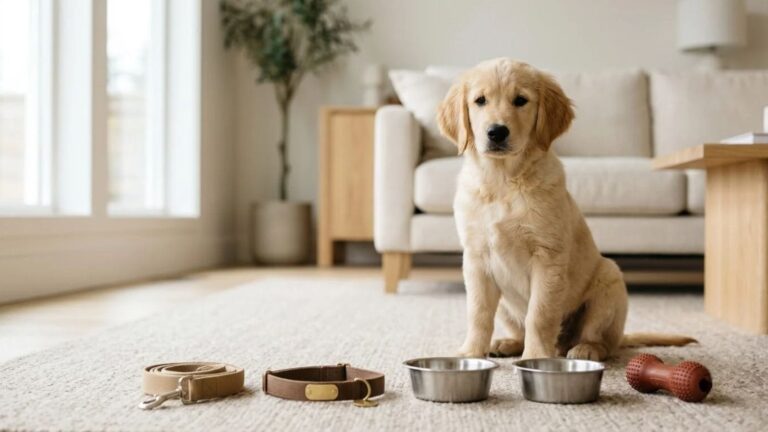
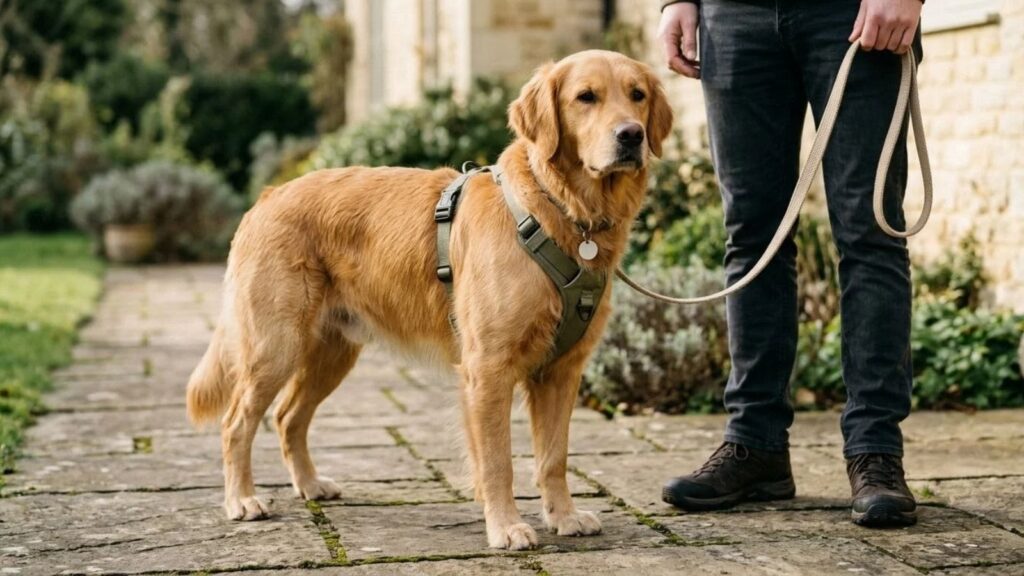
Learning how to choose a dog collar, harness, and leash becomes much easier once you look past matching colors and focus on anatomy and leash habits. Many dogs do well wearing a flat collar for ID tags, a properly fitted chest harness for daily walks and a sturdy standard leash.
This practical buying guide explains how to choose a dog collar, harness, and leash based on your dog’s size, neck sensitivity, pulling behavior and walking routes. If you are preparing for a new arrival, pair this guide with our dog supplies checklist and dog training basics guide.
Affiliate Disclosure: As an Amazon Associate I earn from qualifying purchases. This article contains affiliate links. If you purchase through these links, PawsNPup may earn a commission at no additional cost to you.
Key Takeaways
- A foundational rule in how to choose a dog collar, harness, and leash is keeping ID tags on a flat collar while clipping the leash to a fitted harness to reduce neck pressure.
- Measure neck circumference and widest chest girth before ordering, then check the finished fit for rubbing, restricted movement or gaps that could let your dog back out.
- Understanding how to choose a dog collar, harness, and leash by matching the clip location to leash manners improves handling for both pullers and calm walkers.
- Knowing how to choose a dog collar, harness, and leash includes picking a 4-to-6-foot flat leash for everyday sidewalks, while reserving long lines for open fields on a secure harness.
- Inspecting stitching, buckles and metal D-rings every few weeks and replacing worn webbing early helps prevent hardware failure during outdoor walks.
Four Questions to Ask Before Buying Walking Gear
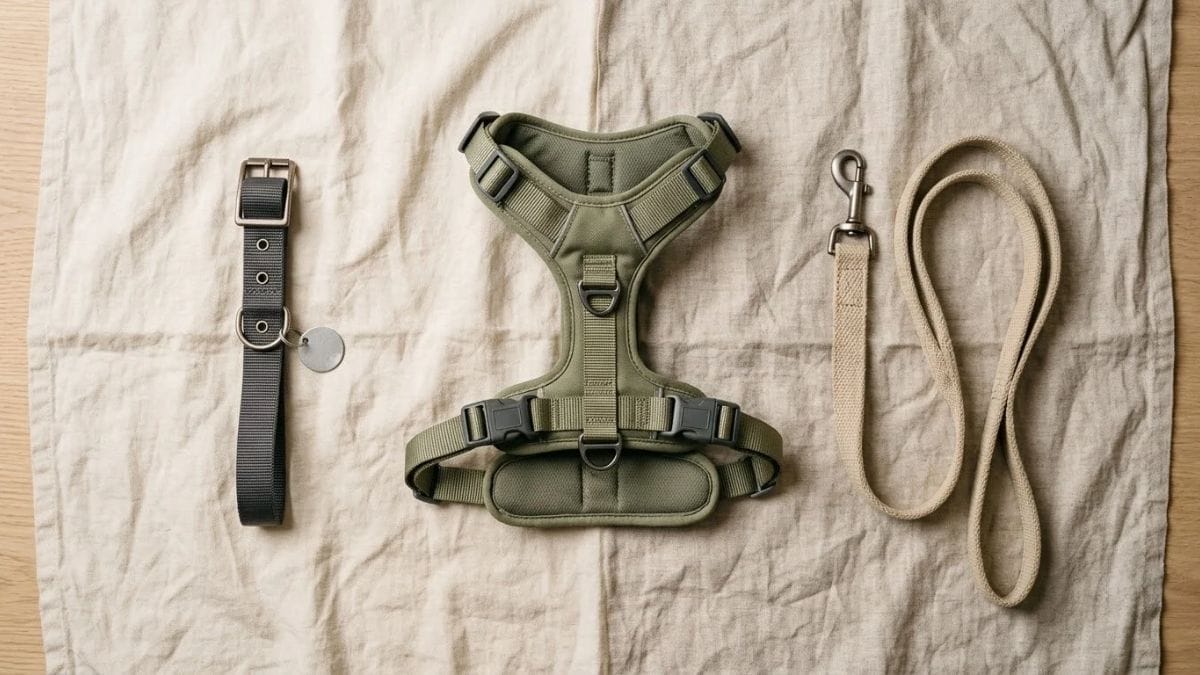
Answering four practical questions before you shop narrows your options when deciding how to choose a dog collar, harness, and leash:
- Does your dog pull or lunge on the leash? A polite loose-leash walker needs simple comfort, whereas a strong puller benefits from chest-steering leverage paired with reward-based training.
- What is your dog’s neck and airway anatomy? Flat-faced breeds, toy dogs with delicate tracheas and narrow-headed sighthounds require very different setups from broad-necked adult dogs.
- Where do you walk most often? Busy city sidewalks, suburban neighborhoods and open recall fields call for different leash lengths and visibility features.
- Does your dog have neck, back or breathing sensitivity? If your dog coughs on a collar or has spinal discomfort, ask your veterinarian which harness cut avoids pressure points.
Collar Types and What Each One Is Actually For
When learning how to choose a dog collar, harness, and leash, treat the collar primarily as an ID carrier rather than a steering tool for strong pullers. As the American Veterinary Medical Association (AVMA) microchipping and ID tag guide notes, wearing a visible collar tag alongside a registered microchip helps clinics reach you quickly
Flat Buckle or Snap Collar
When learning how to choose a dog collar, harness, and leash, a flat collar holds ID tags and suits calm walks. For tag holding, the Ruffwear Front Range Collar is one padded buckle option; verify neck measurements and current listing specs before ordering.
Martingale Collar
A martingale collar uses a limited-cinch loop that tightens to a preset stop when a dog backs up, helping reduce slip-outs compared with a loose flat collar. It suits Greyhounds, Whippets and narrow-headed breeds, though proper adjustment is essential because an over-tightened loop can restrict breathing or still allow escape.
Collars to Approach With Caution
Part of how to choose a dog collar, harness, and leash safely is avoiding choke chains and prong collars. Per the American Veterinary Society of Animal Behavior (AVSAB) position statement on humane dog training, veterinary behaviorists advise against aversive neck tools and leash corrections in favor of reward-based training.
Harness Types and How to Pick Between Them
Understanding harness design is central to how to choose a dog collar, harness, and leash for your dog’s build. How a harness distributes pressure across the chest and shoulders depends directly on its strap cut and fit, and a poorly fitted harness can still press against the lower throat or restrict the neck.
Not every Y-front harness guarantees unrestricted shoulder motion, so ensure straps clear the shoulder blades. For how to choose a dog collar, harness, and leash, compare the padded Ruffwear Front Range Harness with the adjustable Blue-9 Balance Harness, verifying exact sizing and listing details for both before purchase.
| Harness Type | Leash Clip Location | Best Suited For | Key Buying & Fit Considerations |
| Back-clip harness | Between the shoulder blades | Calm adult dogs that walk politely on a loose leash, plus small or flat-faced breeds | Simple to put on and keeps the leash above the back, though it offers less steering leverage if a large dog lunges |
| Front-clip harness | Center of the chest (sternum) | Dogs that pull, lunge or are actively learning loose-leash manners | Can help redirect the chest toward the handler when paired with training, though no single style works best for every pulling dog and a loose chest strap can droop |
| Dual-clip harness | Both chest and back D-rings | Multi-environment walkers or handlers using a double-ended training leash | Lets you clip to the front in busy areas and the back on relaxed walks; growing puppies still need regular strap checks and size upgrades |
| Padded handle harness | Back ring with top lift handle | Hikers or dogs needing brief, gentle guidance over trail obstacles | A dorsal handle aids brief steadying only; do not assume a walking harness handle provides therapeutic mobility support or safe full-body lifting without veterinary guidance |
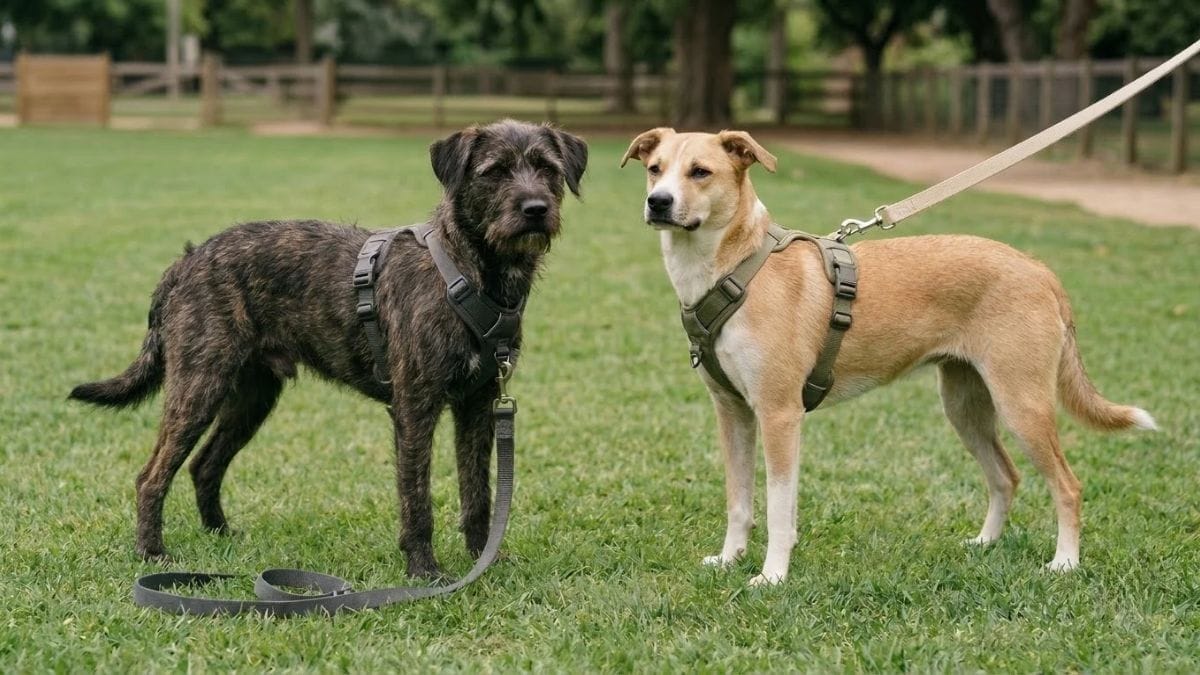
As American Kennel Club (AKC) collar and harness guidance notes, harnesses can help prevent throat pressure in small dogs and flat-faced breeds when matched to individual anatomy and veterinary needs; see our French Bulldog care guide
Leash Types and When to Use Each Length
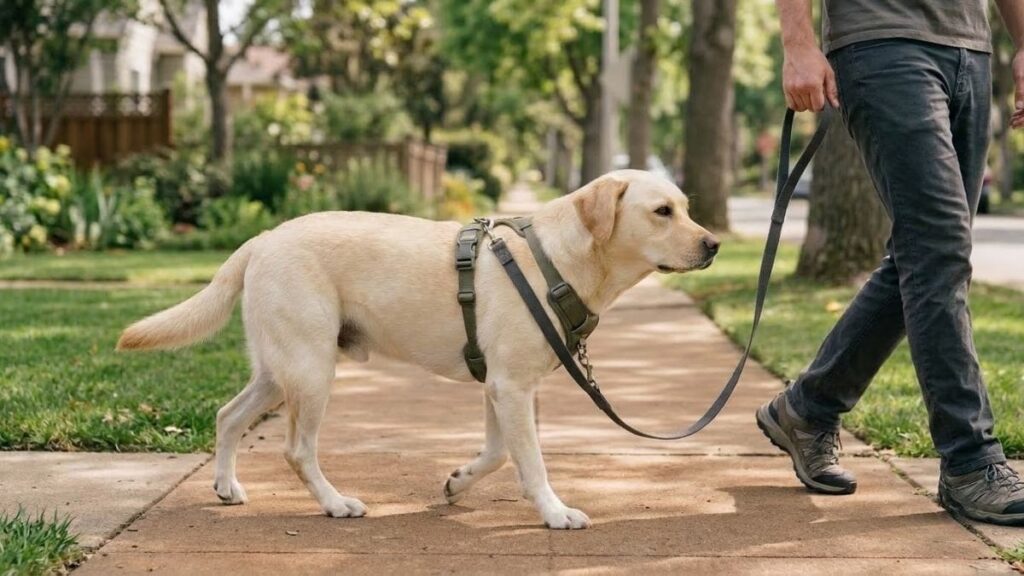
Selecting the right lead is just as important as picking a collar or harness when deciding how to choose a dog collar, harness, and leash for daily routines. Match leash length and handle design to your walking environment:
- Standard flat leash (4 to 6 feet): A versatile everyday option for neighborhood sidewalks, parks and veterinary visits, giving clear communication without excess slack.
- Double-handle flat leash: Adds a second lower traffic loop near the clasp for closer control at crosswalks or vet lobbies; the Max and Neo Double Handle Dog Leash is one dual-handle nylon option, though buyers should verify length, width and current listing specs before ordering.
- Training long line (10 to 30 feet): Useful in open fields for recall practice when clipped securely to a back-clip harness; keep controlled slack, never wrap the line around your hands or fingers, and prevent your dog from hitting the end at a full sprint.
- Short traffic lead (1 to 2 feet): Handy for navigating crowded doorways, elevators or busy urban crosswalks with a large dog.
A Practical Note on Retractable Leashes
When considering how to choose a dog collar, harness, and leash for busy streets, keep in mind that retractable leashes make close control harder near traffic, other dogs and sudden hazards. Their thin cords can also cause cuts or friction burns if tangled around hands or legs.
For puppies learning how to choose a dog collar, harness, and leash setup, a fixed-length leash gives beginners predictable control; see our guide on how much exercise a puppy needs.
Getting the Fit Right: Measuring and Checking Clearance
Accurate sizing makes the biggest difference when learning how to choose a dog collar, harness, and leash, because chest depth and neck circumference vary widely even among littermates. Use a soft tailor’s tape to measure your standing dog before checking any brand’s size chart:
- Measure the neck base: Wrap the tape snugly around the lower neck where a flat collar naturally rests.
- Measure the widest chest girth: Wrap the tape around the deepest part of the ribcage just behind the front legs.
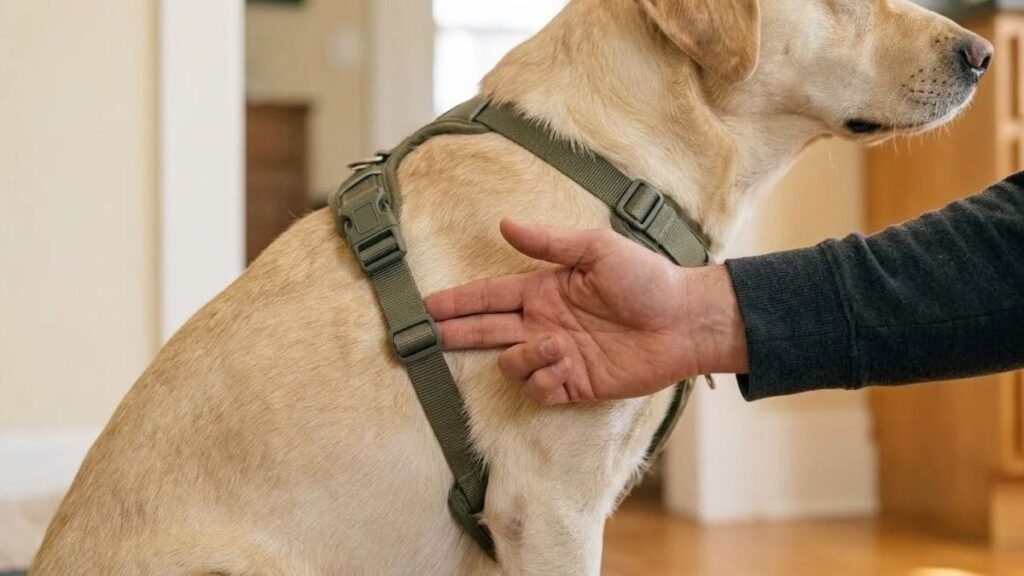
- Use the two-finger check only as a starting point: Slide two fingers flat between the strap and your dog’s body without forcing them. Follow the manufacturer’s fit guidance and check for rubbing, pressure, restricted movement or gaps that could allow escape.
- Verify underarm and shoulder clearance: Leave roughly two fingers of space behind the front legs so straps do not rub raw skin, and recheck fit after the first few walks and as puppies grow.
Material, Hardware and Routine Equipment Inspection
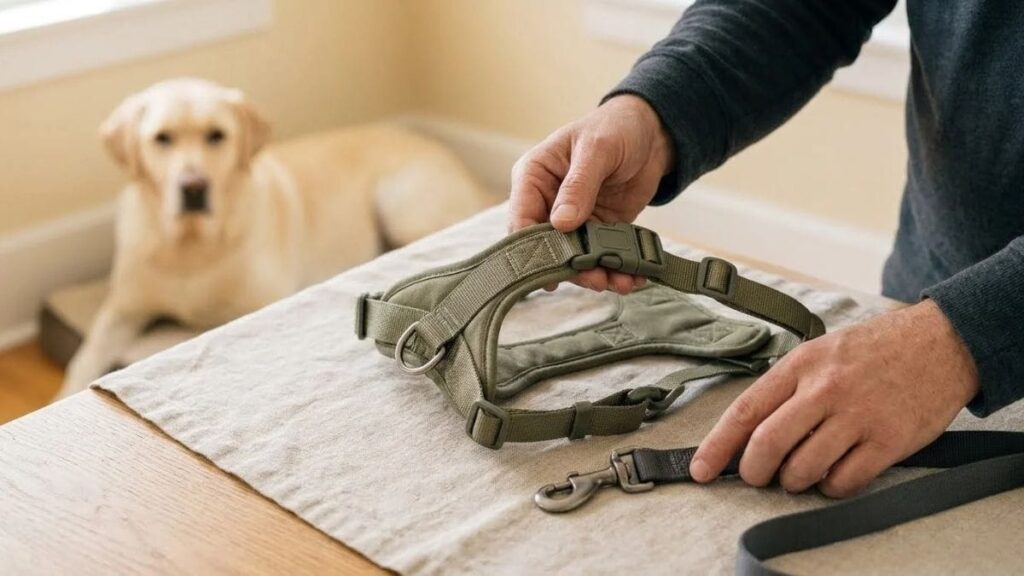
Material choice is another key factor in how to choose a dog collar, harness, and leash for comfort and durability. Nylon webbing is lightweight and easy to wash, conditioned leather may feel softer on some coats once broken in, and mesh panels can help airflow, though rubbing still depends on strap cut and fit.
Knowing how to choose a dog collar, harness, and leash includes checking stitching, D-rings, buckles and clips every few weeks, because hardware strength and construction vary. Replace frayed webbing or cracked clasps immediately, and check footpads via our dog paw care guide.
Simple Decision Guide by Dog Type and Walking Routine
Use this quick reference matrix to apply how to choose a dog collar, harness, and leash across six dog profiles, and verify how to choose a dog collar, harness, and leash for your specific walking environment.
| Your Dog & Walking Situation | Recommended Collar Setup | Recommended Harness & Leash Setup |
| Calm adult dog that walks on a loose leash | Flat buckle collar with engraved ID tag | Back-clip Y-front harness + 4-to-6-foot standard flat leash |
| Dog that pulls or is learning leash manners | Flat buckle collar for ID tags only | Front-clip or dual-clip harness + 4-to-6-foot standard flat leash |
| Growing puppy in training | Lightweight adjustable flat collar checked weekly | Lightweight, adjustable Y-front harness checked weekly + 4-to-6-foot standard leash |
| Small breed or narrow-headed sighthound | Properly adjusted martingale collar or light ID collar | Soft padded harness suited to individual neck anatomy + 4-to-6-foot leash |
| Flat-faced (brachycephalic) breed | Loose flat collar for ID tags only (never for leash tension) | Low-neck padded chest harness tailored to individual anatomy and vet advice + 4-to-6-foot leash |
| Open-field recall training | Flat ID collar with current contact tag | Secure back-clip harness + 15-to-30-foot flat training long line handled without hand wrapping |
Five Common Buying Mistakes to Avoid
Even quality gear causes discomfort or fails early when sized or maintained poorly. Reviewing how to choose a dog collar, harness, and leash helps you avoid these five common mistakes:
- Ordering by breed name instead of tape measurements: Always measure neck and chest girth and check the manufacturer’s exact size chart.
- Sizing down ‘to be safe’: A tight harness pinches behind the elbows and restricts natural shoulder stride.
- Clipping a long line to a neck collar: Always attach a long line to a secure back-clip harness, keep controlled slack without wrapping hands, and avoid sudden full-speed stops.
- Using a long leash on crowded sidewalks: Switch to a 4-to-6-foot leash or short traffic lead in busy public areas.
- Skipping routine fit and wear checks: Check straps every few weeks for frayed stitching, cracked buckles or stretched webbing, and replace worn gear before a failure occurs.
FAQs
Should I use a collar or a harness for walking my dog?
For many dogs, a properly fitted chest harness is a more comfortable everyday walking choice because it can reduce direct pressure on the throat and trachea when fitted well. Keep a flat collar on for ID tags and clip your walking leash to the harness.
Do I need both a collar and a harness?
Using both is a practical setup for most households. A flat collar keeps engraved ID tags and rabies tags on your dog at all times, while a fitted harness handles leash attachment during walks without pulling directly on the neck.
How tight should a dog collar or harness be?
As a preliminary fit check, you should be able to slide two fingers flat between the strap and your dog’s body without forcing them. Confirm that the harness does not rub behind the front legs and cannot slip over your dog’s head if the dog backs up.
What harness style works well for a dog that pulls?
A front-clip or dual-clip Y-front harness often helps manage pulling because clipping at the center of the chest redirects the dog’s torso slightly toward you when tension builds. Pair the harness with positive-reinforcement loose-leash training for lasting improvement.
Are retractable leashes safe for everyday walks?
Retractable leashes make it harder to maintain close control around traffic, other dogs and sudden hazards, and their thin cords can cause friction burns or cuts if tangled around hands or legs. A standard 4-to-6-foot flat leash gives beginners more predictable everyday control.
Conclusion
Knowing how to choose a dog collar, harness, and leash comes down to matching safe, well-fitted gear to your dog’s body shape, pulling habits and walking routes. Using a flat collar for ID tags, a fitted chest harness for steering and a sturdy 4-to-6-foot leash helps protect your dog’s neck.
Every dog has individual physical and behavioral needs, and this guide provides general educational information rather than veterinary advice. Apply how to choose a dog collar, harness, and leash by measuring neck and chest girth first, then visit our dog supplies checklist and dog care tips guide to complete your setup.