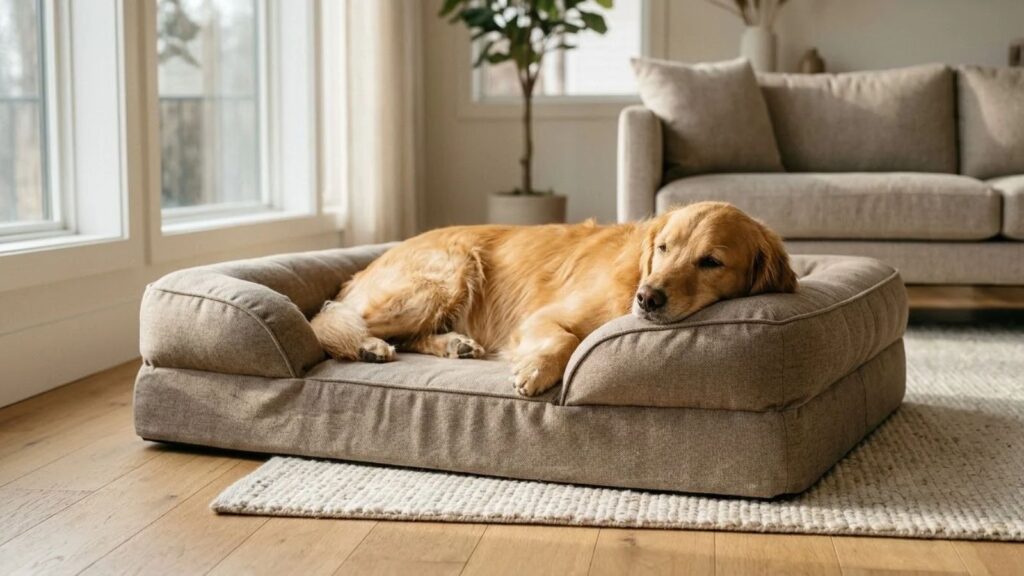
Choosing an orthopedic dog bed comes down to matching supportive foam construction, usable sleeping space and easy-care fabrics to your dog’s body weight and resting habits. A young, lightweight dog may sleep comfortably on standard fiberfill, while a heavier, older or mobility-limited dog may benefit from a more supportive surface that distributes pressure more evenly across the hips, elbows and shoulders.
This guide explains what makes an orthopedic dog bed genuinely supportive, how common foam types compare, how to measure your dog accurately and which practical features matter most. For a broader home-care routine, see our dog care tips guide and dog supplies checklist.
Affiliate Disclosure: As an Amazon Associate I earn from qualifying purchases. This article contains affiliate links. If you purchase through these links, PawsNPup may earn a commission at no additional cost to you.
Key Takeaways
- A supportive orthopedic dog bed uses resilient foam, such as memory foam, solid support foam or a layered combination, rather than loose filling that quickly flattens under body weight.
- Senior dogs, large and giant breeds, lean dogs and dogs with mobility limitations may benefit from supportive bedding placed on stable, non-slip flooring.
- Measuring your dog in a stretched sleeping position and checking the usable interior mattress dimensions helps prevent cramped sleeping space.
- Removable, washable covers and a suitable waterproof liner can protect the foam core from moisture and accidents. Always follow the manufacturer’s cleaning instructions.
- Supervise puppies and dogs that chew bedding. Heated bedding also requires careful attention to the manufacturer’s safety instructions and your dog’s ability to move away from the heat.
What Makes an Orthopedic Dog Bed Genuinely Supportive?
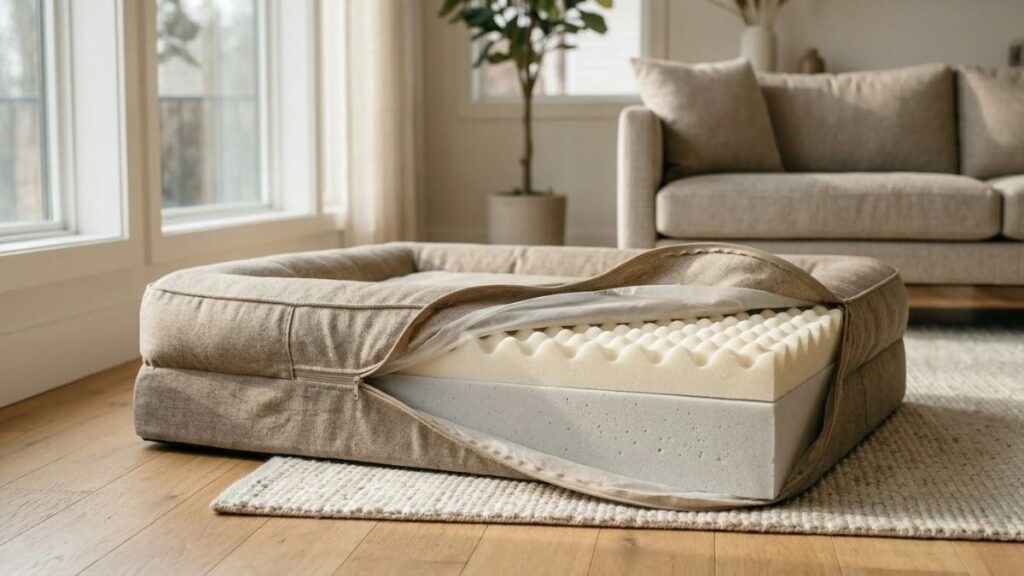
Products marketed as an orthopedic dog bed can have very different internal constructions. Some contain thin padding or loose filling, while others use solid foam, memory foam or multiple foam layers. The label alone does not tell you how supportive a mattress will be.
Look at the actual foam core, its thickness and the way the mattress is constructed. The sleeping surface should provide enough resistance to keep your dog’s body from sinking through to the floor. A bed that feels plush at first may not provide enough support for a heavier dog if its foam compresses too easily.
A simple palm press can help you notice whether the surface collapses immediately under light pressure. However, this is only a rough check. It cannot establish foam density, long-term durability, weight capacity or clinical suitability. Look for clear manufacturer specifications and compare the mattress itself rather than the height of the surrounding bolsters.
A supportive resting surface may improve comfort and reduce pressure from lying on hard flooring. However, an orthopedic dog bed does not diagnose, prevent or cure arthritis, hip dysplasia, elbow hygromas or pressure sores. If your dog has persistent stiffness, swelling, skin changes or difficulty getting up, arrange a veterinary assessment.
Foam Construction and Support Comparison
Understanding the main foam types helps you evaluate an orthopedic dog bed beyond its marketing description.
| Foam construction | Typical construction | Potential benefits | Limitations and what to check |
| Solid support foam | A single block of firm, resilient polyurethane foam | Provides an even sleeping surface and may help heavier dogs avoid sinking onto hard flooring | Can feel firmer than plush beds. Check the actual mattress thickness and support specifications |
| Memory foam | Viscoelastic foam that responds to body heat and pressure | Contours around the body and may help distribute pressure around prominent areas | Lower-quality or thinner layers may compress too much. Some dogs may also find the surface warm |
| Egg-crate or convoluted foam | Foam cut into raised ridges and valleys | Lightweight and often more affordable; may suit lighter dogs or crate pads | The raised sections can compress under heavier dogs and may not provide the same support as a solid foam core |
| Layered foam | A comfort layer over a firmer support base | Combines a contouring surface with a more stable foundation | Check the thickness and material of each layer. Do not assume every layered bed uses high-quality foam |
There is no single foam thickness that suits every dog. Consider your dog’s weight, sleeping posture, the mattress’s resistance to bottoming out and the manufacturer’s stated weight guidance. A heavier dog may need a firmer or more substantial core than a small dog, but the best choice also depends on individual comfort and mobility.
Which Dogs May Benefit Most From an Orthopedic Dog Bed?
Dogs do not need to be old or diagnosed with arthritis to appreciate a supportive sleeping surface. Some dogs may benefit because of their size, body shape, activity level or difficulty getting comfortable on hard flooring.
The Cornell University Richard P. Riney Canine Health Center’s osteoarthritis guide describes signs that can include stiffness after rest, reluctance to walk or climb stairs, difficulty rising and changes in gait. These signs should be discussed with a veterinarian rather than treated as a bedding problem alone.
- Senior dogs and dogs with mobility limitations: Older dogs may spend more time resting. A flat, low-profile mattress can be easier to step onto than a bed with tall sides. See the AVMA senior pet care guidance for broader advice on adapting care as pets age.
- Large and giant breeds: Heavier dogs place more weight on their sleeping surfaces. A supportive mattress with enough usable space may be more comfortable than a thin pad. Explore our guides to big dog breeds and farm dog breeds.
- Lean or bony dogs: Sighthounds and some short-coated dogs have less natural padding over areas such as the hips and elbows. A suitable mattress may make resting on a hard floor more comfortable. It does not, however, prevent or treat pressure sores or elbow hygromas. Persistent swelling or skin changes need veterinary attention.
- Dogs recovering from surgery: Follow the treating veterinarian’s instructions about bedding, confinement and movement restrictions. Buying an orthopedic dog bed does not replace a recovery plan or make an unsuitable sleeping arrangement safe.
Place the bed in a quiet, accessible area where your dog can get on and off without navigating slippery flooring. Cornell’s osteoarthritis guidance discusses home adjustments that can help dogs with mobility difficulties, while the AVMA provides broader senior-pet care guidance. A non-slip rug near the bed may help improve traction. You can also review our dog paw care guide when checking paw condition and grip.
How to Choose the Right Orthopedic Dog Bed Size
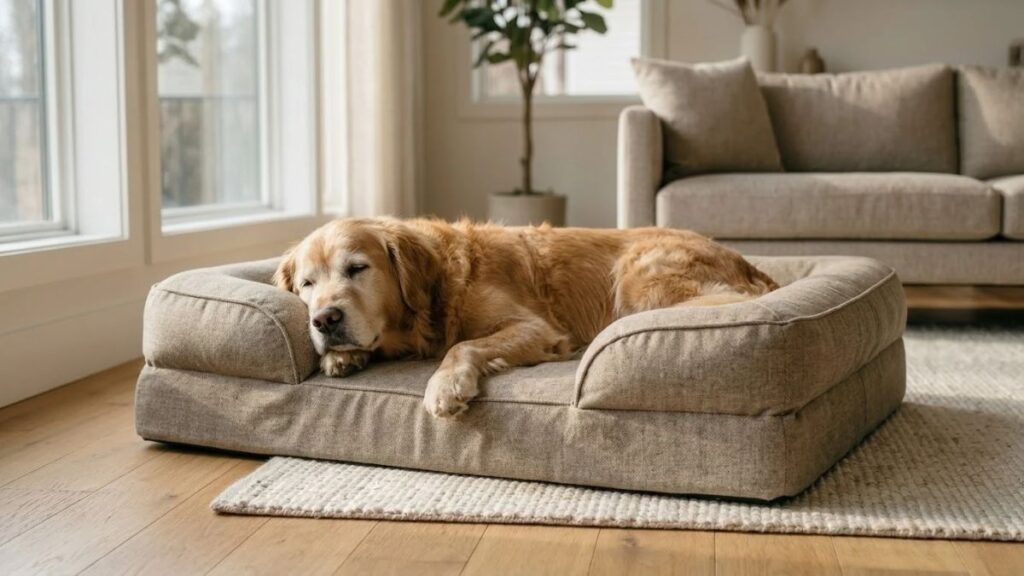
A bed that is too small can force your dog to curl tightly or leave the hips and elbows hanging over the edge. That reduces the usable sleeping area, even if the bed looks large from the outside.
Manufacturers use different size labels, and weight alone does not determine the right fit. Measure your dog before ordering:
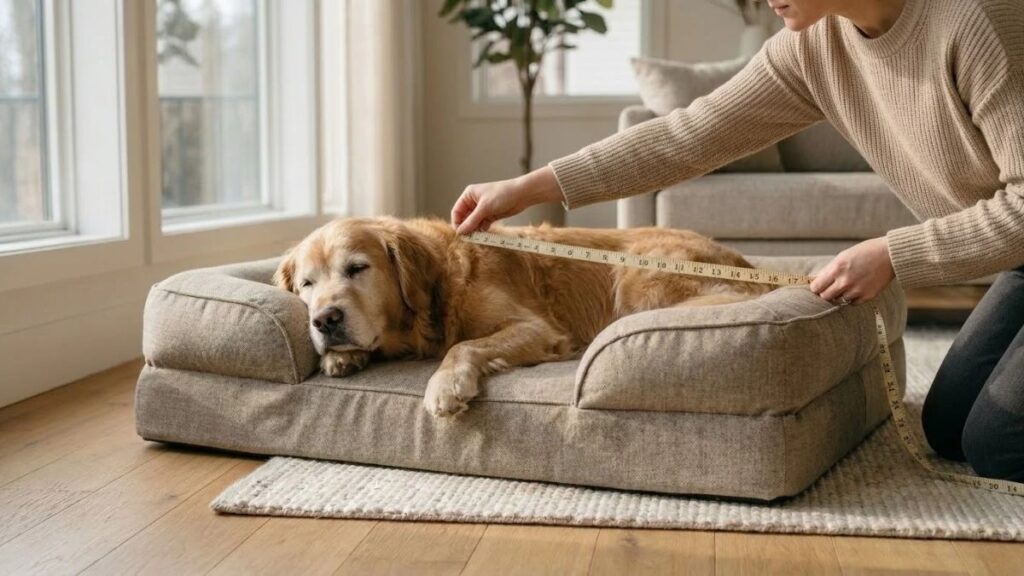
- Measure nose to tail base: Ask your dog to lie on its side in a relaxed, stretched position. Measure from the tip of the nose to the base of the tail, not to the tail tip.
- Measure the curled sleeping position: If your dog usually sleeps curled up, measure across the widest part of that position as well.
- Check the usable mattress area: On a bolstered sofa bed, compare your measurements with the flat interior sleeping surface. Do not rely only on the outside dimensions, which include the bolsters.
- Allow room to change position: Your dog should have enough space to stretch, turn and settle into its preferred sleeping posture. Avoid applying one universal extra-inch rule to every breed and bed design.
Size and Accessibility Considerations
| Dog size | Measurements and sleeping posture | posture Interior space to check | Mobility considerations |
| Toy and small dogs, under 20 lb | Measure nose to tail base and curled diameter. Note whether your dog curls or stretches | Check the flat sleeping area inside the bolsters | A low entry can help short-legged dogs avoid stepping over tall sides |
| Medium dogs, 20 to 50 lb | Measure stretched length and shoulder-to-paw width while lying on the side | Compare the interior mattress dimensions with the dog’s full sleeping length | Check that the mattress does not compress excessively under the hips |
| Large dogs, 50 to 90 lb | Measure full stretched length and allow for leg extension | Subtract the space taken up by bolsters from the outside dimensions | Look for a stable base and an accessible entry if your dog has stiffness |
| Giant breeds, over 90 lb | Measure full length and check the manufacturer’s weight guidance | Confirm that the flat sleeping area is large enough and fits the room | Consider a substantial support core and a low step-on height |
Covers, Waterproof Liners and Cleaning an Orthopedic Dog Bed
Dogs that spend long periods resting can bring dirt, moisture and loose hair into their beds. Older dogs or dogs with incontinence may also need more frequent cleaning. For these reasons, a removable cover and a separate waterproof liner can be useful features when choosing an orthopedic dog bed.
Check whether the outer cover has a zipper and can be removed without struggling to lift or bend the mattress. A waterproof liner beneath the cover can help protect the foam from urine, drool and damp paws. Do not assume every product includes one. Confirm the feature in the exact listing or manufacturer’s care information.
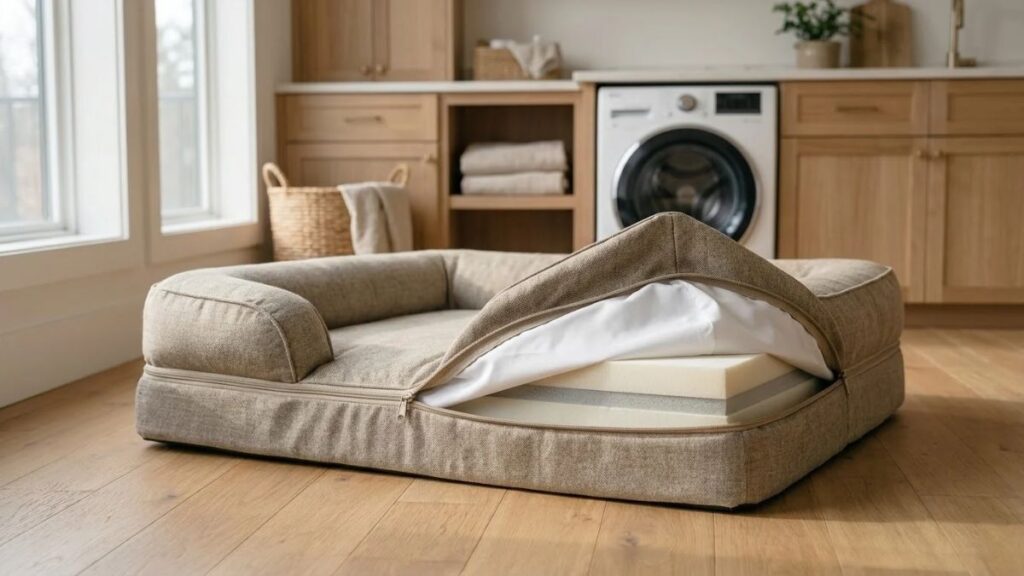
Cleaning instructions depend on the product’s materials. Memory foam and solid support foam cores generally should not be machine-washed unless the manufacturer explicitly says that they can be. Follow the care label, use only the cleaning method recommended for the core and avoid soaking foam unnecessarily. Allow any cleaned foam to dry completely before putting the cover back on.
The ASPCA’s general dog care guidance recommends providing dogs with a warm, quiet resting area away from drafts and keeping their bedding clean. These are useful general care principles, but they should not be treated as product-specific instructions for washing a particular mattress.
A few things matter more than the marketing copy on the package:
- Real foam, not loose fill. Memory foam or high density egg crate foam holds its shape under weight. Loose polyfill flattens out within weeks.
- Enough thickness. For a medium to large dog, look for at least three to four inches of supportive foam, more for bigger breeds.
- Full stretch-out room. The bed should be large enough for your dog to lie fully on their side without hanging off the edge.
- A washable, removable cover. Orthopedic beds get used constantly by dogs who rest more, so easy cleaning matters.
- A non-slip base. A bed that slides on hard flooring can actually discourage a stiff dog from using it at all.
Common Dog Bed Styles
You can choose between several bed shapes depending on how your dog sleeps and where the bed will be used:
- Flat, low-profile mattresses: Provide an unobstructed surface for dogs that stretch out or have difficulty stepping over raised edges.
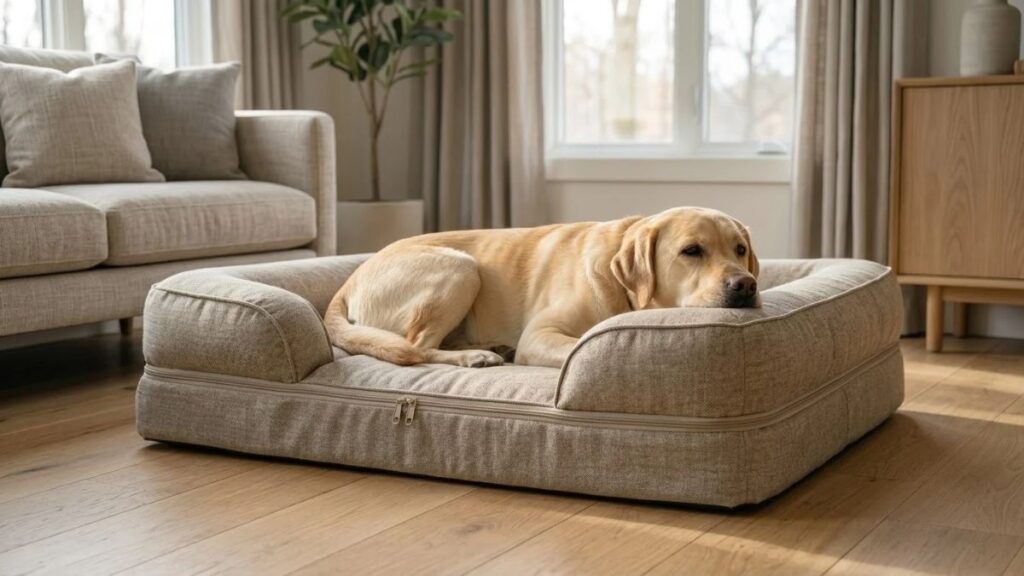
- Bolstered sofa beds: Have raised sides that some dogs enjoy resting their heads against. Check that the front entry is low enough for your dog to use comfortably.
- Crate-compatible pads: Fit inside wire or plastic crates. Some are thinner than standalone mattresses, so check the thickness and support before choosing one for a heavy dog.
Chewing and Heated-Bed Safety Considerations
Foam and heated bedding require different precautions. Consider your dog’s chewing habits, mobility and ability to move freely before choosing either type.
Chewing and foam ingestion: A puppy or destructive chewer may tear open a bed and swallow pieces of memory foam or polyurethane foam. Swallowed material can cause serious gastrointestinal problems, including a possible obstruction. Remove damaged bedding and contact a veterinarian promptly if you suspect your dog has swallowed foam. For dogs that cannot be trusted around plush bedding, use a more suitable, durable resting surface and supervise them. Our puppy exercise guide offers ideas for age-appropriate activity.
Heated bedding: Do not use a human heating pad as a substitute for a pet bed. If you are considering a heated product, choose one specifically designed for pets and follow its manufacturer’s instructions for placement, temperature and supervision. Keep electrical cords out of reach of chewers, inspect them for damage and make sure your dog can move away from the heated area without assistance. Dogs that are immobile, heavily sedated or unable to reposition themselves may be at greater risk of overheating or burns. The AAHA senior-care guidance is a useful additional reference for home care and heating precautions for senior pets.
Three Orthopedic Dog Bed Options to Compare
The following products represent three different bed styles: a bolstered sofa bed, a pet sofa and a memory-foam bolster bed. The supplied shortened Amazon links have resolved to general Amazon landing pages in automated checks, rather than complete product-variant details. The exact ASIN, size, foam construction, dimensions, seller, current ratings and review counts have therefore not been independently confirmed.
Treat these as product listings to investigate, not as fully verified recommendations. Before purchasing, open the exact listing and check the selected size and variant, construction details, cover-care instructions and whether a waterproof liner is included.
1. FurHaven Classic Sofa Orthopedic Dog Bed
The FurHaven Classic Sofa Orthopedic Dog Bed has a three-sided bolster sofa design with a lowered front entry. FurHaven listings can use different foam constructions, including convoluted egg-crate foam and other foam variants.
Check the exact version before ordering. Confirm the foam type, mattress dimensions, available sizes and removable-cover washing instructions. Do not assume that specifications shown for one size or variant apply to another.
2. Bedsure Orthopedic Pet Sofa
The Bedsure Orthopedic Pet Sofa is a bolstered sofa-style option with a lowered front section. Its shape may suit dogs that like resting against raised sides but need a more accessible entry.
Check the live listing to establish whether the selected mattress uses egg-crate foam or solid support foam. Also confirm whether an internal waterproof liner is included, how the cover is cleaned and how much flat sleeping space remains between the bolsters.
3. JOYELF Memory Foam Dog Bed
The JOYELF Memory Foam Dog Bed is presented as a memory-foam bed with surrounding padded bolsters and a removable cover.
Before buying, confirm the foam construction of the selected size, the mattress dimensions, the bolster design and the manufacturer’s washing instructions. Check whether a waterproof liner is included rather than assuming it is part of every version.
Practical Buying Checklist for an Orthopedic Dog Bed
Review these six points before ordering:
- Confirm the foam type and thickness: Look for clear information about solid support foam, memory foam or layered construction. Consider your dog’s weight and whether the mattress may compress too much.
- Measure the usable interior space: Compare your dog’s stretched length or curled sleeping diameter with the flat mattress area, not the outside dimensions.
- Match entry height to mobility: A flat mattress or low front cutout may be easier for senior dogs and dogs with hip or knee stiffness.
- Check the cover and waterproof liner: Confirm that the outer cover is removable and check whether a separate moisture barrier protects the foam.
- Look for a non-slip base: Check the underside for grip on tile or hardwood. If needed, place a suitable non-slip rug pad beneath the bed.
- Consider chewing habits: Avoid leaving a plush foam bed with a dog that regularly tears or swallows bedding. Choose a safer alternative until the behaviour is managed.
FAQs
How do I know if my dog needs an orthopedic dog bed?
Watch for stiffness after naps, hesitation before lying down or standing, frequent changes in sleeping position or a reluctance to settle on hard flooring. These signs can have several causes. Discuss them with your veterinarian to check for joint pain or another underlying problem and ask whether supportive bedding may help.
Are orthopedic dog beds only for senior dogs?
No. Large and giant breeds, lean dogs with little natural padding over their hips and elbows, and dogs with mobility limitations may also appreciate a supportive sleeping surface. Age alone does not determine whether a particular bed is suitable.
What is the difference between memory foam and egg-crate foam in dog beds?
Memory foam is a viscoelastic material that responds to pressure and body heat, allowing it to contour around the body. Egg-crate foam has a ridged surface with raised sections and valleys. It is often lighter, but the ridges may compress more under heavier dogs. A layered design may combine a softer top layer with a firmer support base. Check the actual construction rather than relying on the product name.
Can an orthopedic dog bed cure or prevent arthritis?
No. An orthopedic dog bed may make resting on a hard surface more comfortable, but it does not treat, cure or prevent arthritis, hip dysplasia or elbow hygromas. A veterinarian should assess any dog showing signs of joint pain or mobility changes.
How do I clean an orthopedic dog bed without damaging the foam?
Remove the outer cover and wash it according to the care label. Keep memory foam and support foam cores out of the washing machine unless the manufacturer explicitly permits machine washing. Follow the product’s instructions for spot-cleaning the core, avoid soaking it unnecessarily and allow it to dry completely before reuse.
Conclusion
The right orthopedic dog bed gives your dog a stable, comfortable place to rest without sinking straight through to a hard floor. Focus on the actual foam construction, accurate sleeping-area measurements, an accessible entry height and a removable cover. A waterproof liner and non-slip base can also make everyday care easier.
Choose according to your dog’s body size, sleeping habits and mobility rather than relying on the word orthopedic on a product label. Product specifications can differ between sizes and variants, so check the exact listing before ordering.
This guide provides general educational information, not a veterinary diagnosis or treatment plan. If your dog shows stiffness, swelling, difficulty rising or other mobility changes, consult your veterinarian. Measuring your dog’s sleeping length is a useful first step towards finding a bed that fits comfortably.