
Clicker training essentials come down to one idea: a click marks the exact moment your cat does something right, and a reward follows. PetMD and the Feline Veterinary Medical Association (FelineVMA, formerly AAFP) both describe the method. This guide covers the tools, the steps, common mistakes and when to see a vet.
The original post gave exact timelines and a study claim we could not confirm. Those are removed or labeled. This is general information, not veterinary advice.
Key Takeaways
- PetMD says to choose a clicker sound your cat is not afraid of.
- PetMD suggests 20 two-minute sessions a week rather than two 20-minute ones.
- The FelineVMA says some cats find the clicker too loud, so muffle it or use a word instead.
- The FelineVMA says to reward right after the behavior.
- Punishment is not part of the method. See a vet if behavior changes suddenly.
What Is Clicker Training?

The FelineVMA describes a clicker as a conditioned reinforcer: a sound that marks the exact moment of the behavior, with the reward following as soon as possible. PetMD says any cat that is food- or toy-motivated and not afraid of the click can be trained.
PetMD says kittens seem easier to train than some adult cats. We removed the original claim that cats are “independent thinkers” who respond only to rewards, since the sources do not say so.
Tools You Need
PetMD says to pick a clicker whose sound your cat does not fear, and to gather treats your cat loves. It suggests small, tasty morsels, such as lickable treats or bits of wet food on a spoon, and treats or toys kept only for training.
The FelineVMA suggests testing a few rewards to see which the cat chooses, and rechecking because preferences change day to day. In the study it cites, cats picked human interaction most often, then food, then toys. Our suggestion: keep a few options ready.
If the Clicker Is Too Loud
The FelineVMA notes some cats learn more slowly with a clicker and that the sound can be too loud. It suggests keeping the clicker in a pocket or wrapping it in cloth. A word, a hand signal or a target stick can serve as the marker instead. It recommends hand signals for deaf cats and cats highly reactive to sound.
Getting Started: Space and Rewards
The FelineVMA says to train when the reward is desirable and to avoid distractions. Our suggestions: use a quiet room, the same spot each time and a mat or blanket as a base. See our essential cat products guide for other supplies.
Clicker Training Essentials: Step by Step

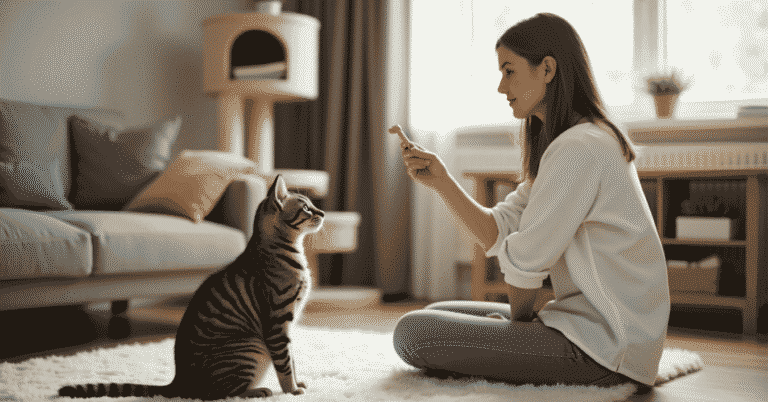
PetMD gives three steps. First, choose the clicker and treats. Second, start with a behavior your cat offers easily, such as sitting. When the cat sits, click and give a treat immediately. Third, say a cue such as “sit” just before the behavior, then click and reward.
PetMD does not describe “charging” the clicker with a set number of repeats, so we removed the original 10 to 15 figure. It says only that early on the treat should follow the click with minimal delay. PetMD suggests a treat after every click.
Shaping and Other Methods
The FelineVMA lists several techniques. Shaping teaches a behavior in small steps and rewards each one. Luring uses a treat or toy to guide the cat. Targeting teaches the cat to touch a target stick. Capturing rewards behaviors the cat already offers, such as sitting while waiting for a meal.
Once a behavior is reliable, it says to add a cue and have the cue come just before the behavior. PetMD names sit, stay and high five as examples.
Using the Clicker Instead of Punishment
PetMD does not describe the clicker as a way to stop unwanted behavior directly. Its examples reward the behavior you want, such as clicking when a cat gets off the counter. The FelineVMA says to reward alternatives, such as treats when a cat uses a perch instead of the counter.
For scratching, PetMD says to place posts near furniture the cat targets and reward use. For biting, it says to redirect to a toy and watch for warning signs such as flattened ears. See our cat training guide.
How Long Does It Take?
PetMD says learning a new cue can take a few days or several weeks. The original post gave week-by-week milestones and age-based timelines. We found no source for them, so they are removed.
PetMD says to keep sessions short and stop while the cat is still engaged. It suggests 20 two-minute sessions a week. The original said 5 to 7 minutes, two to three times a day. The sources give different figures, so start short and watch your cat.
Mistakes to Avoid

PetMD says to give a treat after every click. Clicking without a reward teaches the cat the sound means nothing. The FelineVMA says to deliver the reward immediately after the behavior.
If your cat shows frustration, the FelineVMA says to end on a good note. If the behavior does not change, try another highly preferred reward. Everyone in the home should use the same cues. Our suggestion: agree on them first.
Several Cats, Seniors and Anxiety
The sources we opened do not cover multi-cat homes, older cats or anxious cats. Our suggestion is to train cats separately at first and keep sessions gentle. The FelineVMA says fear, pain or illness can reduce learning, so check with a vet when a cat will not engage.
Can You Stop Using Treats?
The sources we opened do not say how to phase out treats. The FelineVMA says rewards must keep strengthening the behavior. Ask a vet or certified behaviorist if you want a plan for fading rewards.
FAQs
Can I use clicker training for anxiety?
The sources we opened do not cover anxiety. See a vet first, then ask about a behaviorist. See also calm a stressed cat.
How long should each session be?
PetMD suggests two-minute sessions, 20 a week, and stopping while your cat is still engaged.
What if my cat ignores the clicker?
The FelineVMA says to try another highly preferred reward and to check whether the sound is too loud. PetMD says the cat must not be afraid of the click.
Is it safe for older cats?
We found no source on older cats. Check with a vet about mobility and health first.
Do I need treats forever?
The sources we opened do not say. The FelineVMA says to use a reward that works.
Conclusion
Clicker training essentials are a clicker or other marker, rewards your cat loves, short sessions and quick timing. Use rewards, not punishment, and see a vet if behavior changes suddenly.