
Introduction to Cat Training
Cat training begins with understanding why it matters—for you and your feline. This guide gives you easy, friendly steps to a happier, well-behaved cat and a more peaceful home.
Why Train Your Cat?

Most people think of dogs when they hear the word “training,” but cats can be just as responsive—if not more so—when trained properly. Training your cat isn’t just about teaching tricks; it’s about building a better bond, preventing destructive behavior, and creating a peaceful, happy home.
Cats are smart, curious creatures. When left to their own devices, that curiosity can lead to shredded furniture, knocked-over plants, or unwanted behavior. Training provides the structure your cat needs to channel that energy in healthy ways. It also helps with things like traveling, vet visits, and even grooming sessions.
There’s also the safety factor. A trained cat is more likely to come when called, stay calm during emergencies, and avoid hazards. Whether you’re training a kitten or an older cat, the process is enriching for both of you. Think of it as your mutual language of trust.
So if you’ve ever been told “cats can’t be trained,” think again. With patience, consistency, and the right approach, your feline friend can learn just about anything.
Myths About Cat Training Debunked
Let’s tackle some common myths that keep cat owners from even trying to train their pets.
Myth 1: Cats are too independent to train.
Truth: Yes, cats are independent. But that doesn’t mean they can’t learn. In fact, they thrive when given the opportunity to problem-solve and interact with their humans.
Myth 2: Only kittens can be trained.
Truth: While kittens may be more impressionable, adult cats can absolutely learn new behaviors. It might take more time, but it’s completely possible.
Myth 3: Training a cat means punishing it.
Truth: The best cat training is based on positive reinforcement, not punishment. This means rewarding good behavior rather than scolding bad behavior.
Myth 4: Training is only for tricks.
Truth: Sure, tricks are fun, but training can address real-life needs like using the litter box, not scratching the couch, or coming when called.
In reality, cat training is more about understanding than dominance. It’s not about making your cat obey you—it’s about creating mutual respect and communication.
Table of Contents
Understanding Your Cat’s Behavior

Natural Instincts and Communication
If you want to train your cat successfully, you have to first understand how they think. Cats are predators by nature. That means they’re driven by instinct, curiosity, and a desire for control over their environment.
Cats communicate differently than dogs or humans. They use subtle body language: tail movements, ear position, blinking, purring, and vocalizations. For instance, a flicking tail might mean your cat is annoyed, while slow blinking shows trust.
Understanding these signals will help you tailor your training sessions. If your cat is showing signs of stress or disinterest, pushing forward can backfire. But if they’re curious and alert, that’s your green light.
Also, cats are territorial. They feel safest in familiar spaces and routines. That’s why abrupt changes can cause stress—and stress leads to unwanted behaviors like hiding, aggression, or going outside the litter box. Training should be consistent and always done in an environment where the cat feels safe.
When you see the world through your cat’s eyes, you’ll start to understand what motivates them—and that’s key to effective training.
How Cats Learn: The Basics of Feline Psychology
Cats learn through association. If doing something brings a reward, they’ll repeat it. If it leads to discomfort, they’ll avoid it—though you have to be careful with negative experiences, because cats can also associate them with you, not just the behavior.
Here’s how cats typically learn:
- Observation: They watch your actions and other pets in the home.
- Trial and Error: If they knock something off a table and it makes a noise, they’ll either find it fun or scary.
- Positive Reinforcement: A treat or praise following a behavior increases the likelihood they’ll repeat it.
That’s why consistency is so important. If you let your cat on the counter one day and scold them the next, they’ll just get confused. A confused cat is harder to train.
Use high-value rewards—tiny pieces of cooked chicken or a favorite treat—and repeat actions until they stick. Short, daily sessions work better than long, infrequent ones. Keep it playful and low-pressure.
In essence, cats learn what works for them. Your job is to make good behavior the most rewarding option.
Preparing for Cat Training

Setting Realistic Goals
Before diving into training, think about what you want your cat to learn. Start small. Don’t aim for agility-course mastery on day one. Maybe your first goal is teaching them to sit on command, stop jumping on counters, or simply respond to their name.
Cats have short attention spans. A good training goal is something simple, achievable, and measurable. For example:
- “My cat will sit when I say ‘sit’ within two weeks.”
- “My cat will stop scratching the couch by next month.”
- “My cat will come when called by the end of the week.”
These goals give you a target and help keep your efforts focused. Trying to fix everything at once leads to frustration—for both of you.
Also, consider your cat’s personality. Some cats are more social and food-motivated, while others are more independent. Tailor your goals based on their natural tendencies.
And remember—every small win counts. If your cat just learns to sit still for 5 seconds while you clip a nail, that’s progress worth celebrating.
Essential Tools for Training
You don’t need a huge budget or fancy gadgets to train your cat. But a few tools can make things easier:
- Clicker: A small device that makes a clicking sound to mark good behavior.
- Treats: Small, tasty, and irresistible. Go for high-value rewards.
- Toys: Wand toys, laser pointers, and puzzle feeders can be used as both motivation and reward.
- Training Mat or Perch: A specific space your cat can associate with training time.
- Litter box essentials: For toilet training, clean and accessible litter boxes are key.
Also, keep a training log. Note what your cat responds to, how long sessions last, and what progress you see. This helps fine-tune your strategy and stay consistent.
With the right tools and mindset, you’re already halfway there.
Litter Box Training

Choosing the Right Litter Box and Placement
Believe it or not, litter box training is one of the easiest parts of cat training—if you do it right from the start. Most cats have a natural instinct to bury their waste, but they need the right setup to feel comfortable.
Here’s what to look for:
- Size: Bigger is usually better. Your cat should be able to turn around comfortably.
- Type: Covered or uncovered? Covered boxes offer privacy but can trap odors. Some cats prefer the openness of an uncovered box.
- Location: Quiet, low-traffic areas are best. Avoid putting the box near noisy appliances or in corners where the cat might feel trapped.
- Number: The golden rule is one box per cat, plus one extra.
And don’t forget the litter itself. Some cats are picky about texture and scent. Unscented, clumping litter is usually a safe bet.
Clean the box daily. Cats are clean animals, and a dirty box is a major reason they’ll go elsewhere.
Now that the setup’s right, it’s time to teach the behavior itself.
Step-by-Step Litter Training Guide
Litter box training is often instinctual, but a structured approach ensures your cat develops lifelong good habits. Here’s how to train your cat or kitten to use the litter box like a pro.
Step 1: Introduce the Litter Box Early
For kittens, introduce the litter box as soon as they’re mobile—around 3–4 weeks of age. Gently place them in the box after meals or naps to reinforce the habit.
Step 2: Monitor and Guide Behavior
Watch your cat closely after meals or play sessions. If you see them sniffing or circling—a sign they need to go—gently carry them to the litter box. Let them dig around and get used to the texture.
Step 3: Positive Reinforcement
Every time your cat uses the litter box correctly, reward them. Use treats, petting, or verbal praise. Never punish them for accidents—this can lead to fear and hiding the behavior.
Step 4: Handle Accidents Calmly
If your cat goes outside the box, clean the area thoroughly with an enzymatic cleaner to remove odors. Avoid ammonia-based cleaners, which smell like urine and can attract them back.
Step 5: Stay Consistent
Consistency is everything. Keep the litter box in the same spot and maintain a regular cleaning schedule. Any major changes can confuse your cat and disrupt their routine.
Litter training doesn’t require harsh discipline—just patience, understanding, and a clean, inviting environment. Within days to weeks, most cats become litter box pros.
Basic Commands and Behavioral Training

Teaching “Sit,” “Come,” and “No”
Yes, cats can learn commands just like dogs! It’s all about timing, tone, and motivation. Let’s break down the three most practical ones:
“Sit” Command
- Hold a treat just above your cat’s head and move it slightly back.
- As they look up, they’ll naturally sit.
- The moment their rear touches the ground, say “Sit” and click (if using a clicker).
- Give the treat immediately.
Repeat several times daily. Keep sessions short—5 minutes max. In a week or two, your cat should respond consistently.
“Come” Command
Use their name with a cheerful tone, then say “Come” while showing a treat or toy.
- Reward them each time they respond.
- Practice from different distances.
- Gradually phase out the treats as the behavior becomes automatic.
“Come” is incredibly useful—especially if your cat ever slips outside or you need to redirect their attention quickly. The International Cat Care organization recommends recall as a core behavior every cat should learn.
“No” Command
Cats don’t always respond to harsh tones, so avoid shouting. Instead, use a firm “No” while gently removing them from the forbidden action (e.g., scratching furniture).
Then redirect them:
- If scratching the couch, move them to a scratching post.
- If jumping on counters, place them back on the floor and reward them for staying down.
This creates clarity: “This behavior ends the fun, but that behavior gets rewarded.”
Training these commands builds mutual respect and reinforces your role as a trusted guide—not a dictator.
Redirecting Unwanted Behaviors
Cats aren’t being “bad” when they scratch, jump, or bite—they’re being cats. The trick is to redirect those instincts into more acceptable outlets.
Scratching Furniture?
- Place a scratching post near the problem area.
- Rub it with catnip or dangle a toy to attract attention.
- Reward them every time they use it.
Jumping on Counters?
- Make the surface unappealing with double-sided tape or aluminum foil.
- Offer a nearby cat tree or perch instead.
- Reward ground-level playtime.
Biting During Play?
- Stop play immediately when teeth touch skin.
- Offer chew toys and praise when used appropriately.
- Avoid using your hands as toys.
Nighttime Zoomies?
- Increase interactive playtime during the day.
- Offer puzzle feeders before bedtime to tire them out.
In short, don’t punish—redirect. Show your cat a better alternative and reward them for choosing it. Over time, you’ll see major improvements.
Clicker Training for Cats

What is Clicker Training?
Clicker training is one of the most effective—and fun—ways to teach your cat new behaviors. It’s based on a simple concept: the click marks the exact moment your cat does something right, followed by a reward.
Why does it work so well?
Because it removes ambiguity. The click sound is distinct and consistent, helping your cat clearly link behavior with reward. It’s fast, effective, and builds trust.
Clicker training works for:
- Basic commands like “sit” or “stay”
- Fun tricks like “high five”
- Reducing unwanted behaviors
- Socialization and vet handling
Cats love clicker training because it turns learning into a game—and who doesn’t love a game with treats?
How to Start Clicker Training
Getting started is easy, but consistency is key. Here’s your step-by-step beginner guide:
Step 1: Get a Clicker and Treats
Buy a basic clicker (they’re cheap!) and choose small, high-reward treats your cat loves. The treat should be immediate and irresistible.
Step 2: “Charge” the Clicker
Before giving commands, associate the click with something good. Click → Treat. Do this 10–15 times in a row. Soon, your cat will perk up at the sound.
Step 3: Pair with Behavior
Now it’s time to add a cue. Let’s say you want to teach “Sit”:
- Wait for your cat to naturally sit or guide them using a treat.
- The moment they sit: Click → Reward.
- Repeat daily.
Step 4: Add Verbal Commands
Once your cat starts doing the behavior consistently, start saying the command before the action: “Sit” → Cat sits → Click → Treat.
Step 5: Be Patient and Keep Sessions Short
Train for 3–5 minutes a couple of times a day. Always end on a high note to keep it fun.
With regular practice, your cat will begin to connect verbal cues, actions, and rewards—unlocking a whole new level of communication.
Socialization and Handling

Training Your Cat to Enjoy Human Contact
Some cats are naturally cuddly. Others—not so much. Whether you have a kitten or a skittish adult, socialization is key to helping your cat feel safe and relaxed around people.
Start Small and Slow
Let your cat come to you. Sit on the floor, avoid sudden movements, and talk softly. Offer treats when they approach or allow gentle touch.
Use Touch Gradually
Begin with petting areas they’re comfortable with—usually around the cheeks or under the chin. Slowly introduce touch to paws, ears, and belly over time. This helps prepare them for grooming, vet visits, and nail trims.
Daily Handling Exercises
Even 5 minutes a day can make a difference. Gently pick them up, touch their paws, and mimic vet handling with positive reinforcement.
Watch for Signs of Stress
If your cat’s tail starts twitching or their ears go back, stop and give them space. Never force contact.
Over weeks and months, your cat will learn that handling is not just tolerable—it’s rewarding.
Introducing Your Cat to Other Pets
Bringing a new cat or pet into the home? Proper introductions prevent turf wars and stress.
Step-by-Step Introduction:
- Separate Spaces: Keep pets in separate rooms at first.
- Scent Swapping: Rub each animal with a soft cloth and place it in the other’s area.
- Visual Introduction: Use a baby gate or cracked door so they can see but not touch.
- Supervised Meetings: Keep sessions short and positive with treats or toys.
- Gradual Integration: Increase time together as they show calm behavior.
Always monitor for aggressive body language—hissing, puffed tails, growling—and separate if needed.
Socializing your cat isn’t just about having a peaceful household—it helps your cat feel more confident and secure, no matter what life throws their way.
Training Kittens vs. Adult Cats

Key Differences in Training Age Groups
Training a kitten is not the same as training an adult cat—and knowing the difference can save you a ton of time and frustration.
Kittens are Like Sponges
Kittens between 8 and 16 weeks are in a prime socialization period. They’re naturally curious, less fearful, and eager to interact. This is the ideal time to:
- Introduce handling (paws, ears, etc.)
- Litter box train
- Get them used to other pets or children
- Start basic command training
They’re more open to new experiences, and with regular, short training sessions, you’ll see progress almost daily.
Adult Cats Require Patience
Older cats might have set routines—and sometimes, bad habits. They may be more cautious or even fearful of change. But don’t let that discourage you. With slow, consistent training, even older cats can learn:
- New commands
- How to stop undesirable behavior
- How to interact with new environments or people
You just have to move at their pace. Think of adult cat training like undoing years of programming—you need time, consistency, and lots of patience.
Whether you’re working with a kitten or a mature feline, the key is to respect their boundaries and celebrate every little win. Progress is still progress.
When and How to Start Training
The best time to start training? Right now. Whether your cat is 8 weeks or 8 years old, the sooner you begin, the better.
For Kittens:
- Start by teaching their name and litter box use.
- Use toys to build positive interaction.
- Train short commands like “come” or “sit” early on.
For Adult Cats:
- Begin with bonding activities to build trust.
- Use clicker training to shape simple behaviors.
- Avoid overwhelming them with long or intense sessions.
Here’s a quick training timeline you can follow:
| Age of Cat | Ideal Training Focus |
|---|---|
| 2–3 months | Litter box, name recognition, gentle handling |
| 4–6 months | Basic commands, scratching post use, clicker introduction |
| 6+ months | Advanced tricks, behavior redirection, socialization |
Remember, cats don’t “grow out” of bad behavior—they grow into habits. That’s why the best time to start training is always today.
Solving Common Behavioral Problems
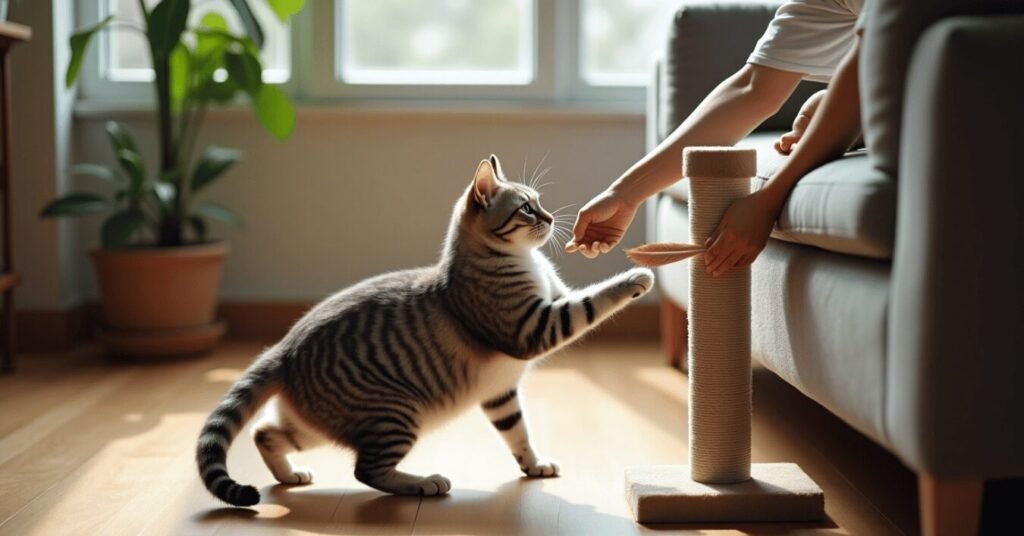
Scratching Furniture
If your cat’s claws are turning your couch into confetti, you’re not alone. Scratching is a natural behavior—they do it to mark territory, stretch muscles, and keep claws sharp. But your furniture doesn’t have to suffer.
Here’s how to stop the madness:
- Provide Alternatives:
- Place a sturdy scratching post near the furniture they target.
- Try cardboard scratchers, sisal posts, or even horizontal options.
- Make Furniture Unappealing:
- Use double-sided tape or furniture-safe repellents.
- Cover favorite scratching spots temporarily.
- Encourage the Right Spot:
- Sprinkle catnip or hang toys from the scratching post.
- Reward every use with praise or treats.
- Trim Claws Regularly:
- Short claws do less damage.
- Get your cat comfortable with paw handling first.
- Stay Consistent:
- Don’t let one “cute scratch” slide.
- Redirect every single time.
Punishment doesn’t work here—it’ll only confuse or scare your cat. Instead, make the desired behavior easier and more rewarding than the problem behavior.
Biting and Aggression
Aggression in cats can stem from fear, overstimulation, or territorial disputes. If your cat bites during play or lashes out unexpectedly, it’s time to look deeper.
Why it Happens:
- Play aggression: Often in kittens or under-stimulated adults.
- Fear-based aggression: From past trauma or lack of socialization.
- Redirected aggression: Frustration taken out on an innocent party.
- Pain-related aggression: A sign of medical issues.
What to Do:
- Stop using hands as toys. Always use a wand toy or feather.
- End play immediately if your cat gets too rough.
- Watch for warning signs—twitching tail, flattened ears, or dilated pupils mean “back off.”
- Use calming pheromones or enrichment tools.
- Consult a vet or behaviorist if biting persists or escalates.
Never punish a cat for aggression—it only builds mistrust. Instead, focus on preventing triggers and creating safe, enriching alternatives.
Advanced Cat Tricks and Enrichment
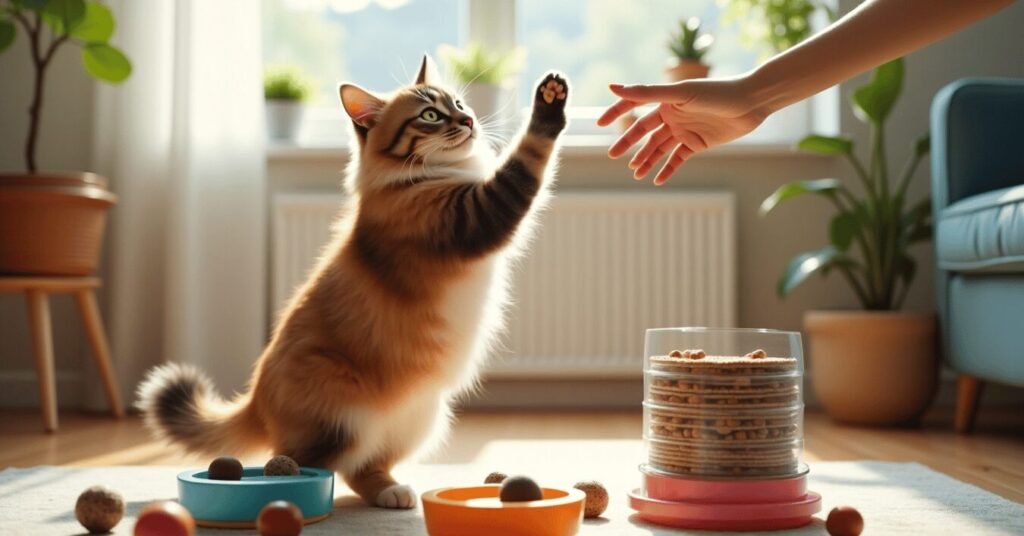
Fun Tricks Like High-Five or Fetch
Once your cat has nailed the basics, it’s time to level up with some advanced tricks that add excitement and mental stimulation.
Trick 1: High-Five
- Hold a treat in your closed hand near your cat’s paw.
- Wait until they paw at your hand.
- Say “High five,” click, and reward.
- Repeat until they raise their paw consistently on cue.
Trick 2: Fetch
Yes, some cats fetch! Start by:
- Tossing a small toy a short distance.
- Encouraging your cat to chase and bring it back.
- Rewarding immediately with a treat or praise.
Trick 3: Spin
- Use a treat to guide your cat in a full circle.
- Say “Spin,” click, and treat.
- Practice in both directions to balance coordination.
These tricks are more than party tricks—they build confidence, reduce boredom, and deepen your bond.
Mental Stimulation and Puzzle Games
Cats need mental workouts as much as physical ones. Boredom leads to trouble—scratching, yowling, or even depression. Keep their minds sharp with:
- Puzzle feeders: Make them “hunt” for their kibble.
- Treat balls: Dispense snacks as they roll.
- Interactive toys: Battery-powered mice or moving lasers.
- DIY challenges: Hide treats in boxes or under cups.
You can even rotate toys weekly to keep things fresh. Remember, a tired cat is a happy cat—and a mentally stimulated one is a well-behaved companion.
Using Positive Reinforcement Effectively

Best Treats and Rewards for Training
Not all treats are created equal in your cat’s eyes. The right reward can make or break your training success.
Top Training Treats:
- Freeze-dried chicken or fish
- Tiny pieces of cooked meat (like turkey or salmon)
- Commercial cat treats (like Temptations or Churu)
- Low-calorie dental treats (for regular use)
Other Rewards:
- Extra petting or brushing (if your cat enjoys it)
- A quick play session
- Access to a favorite perch or room
Keep treat sizes tiny—training involves repetition, and you don’t want a chunky kitty. Rotate high-value treats occasionally to keep motivation high.
Timing and Consistency in Reinforcement
Timing is everything. If the reward comes too late, your cat won’t link it to the behavior you’re praising.
Best Practices:
- Reward immediately—within 1–2 seconds of the action.
- Be consistent with cues and rewards.
- Avoid mixed signals. If one day jumping on the table is allowed and the next it’s not, your cat will get confused.
Keep your training language consistent too:
- Always say “Sit,” not “Sit down,” “Sit now,” or “Can you sit?”
Stick to short, positive sessions—2 to 5 minutes, 2–3 times daily is ideal. With consistency and clear communication, your cat will not only learn but enjoy the process.
Mistakes to Avoid in Cat Training

Punishment vs. Discipline
One of the biggest traps cat owners fall into is mistaking punishment for discipline. And let’s be real—yelling at your cat rarely works. It can actually break trust and worsen the behavior.
What Doesn’t Work:
- Yelling or clapping loudly
- Spraying water
- Swatting or physically moving your cat aggressively
- Isolating your cat in a room
These methods confuse your cat. They won’t understand why you’re mad and may associate the punishment with you, not the behavior. This leads to anxiety, hiding, and broken bonds.
What Does Work:
- Redirecting behavior (e.g., from the couch to a scratching post)
- Consistent, calm correction like a firm “No” and removing them from the action
- Rewarding desired behavior so it replaces the problem
Training isn’t about control—it’s about communication. Cats don’t respond to dominance; they respond to mutual respect and positive reinforcement.
Overtraining and Confusing Signals
Just like humans, cats get overwhelmed when too much is thrown at them at once. Overtraining can lead to burnout, confusion, and regression.
Signs You’re Doing Too Much:
- Your cat walks away mid-session
- They start hiding when they see you grab the clicker
- They get cranky or swat during what used to be fun time
Fix It With:
- Shorter sessions (3–5 minutes max)
- Focusing on one command at a time
- Ending sessions on a high note (with a win and a treat)
Consistency matters more than intensity. Also, make sure all family members use the same cues and rewards. Mixed messages will leave your cat unsure of what’s expected—and that’s when they stop responding.
Creating a Long-Term Training Plan

Maintaining Good Habits Over Time
You’ve taught your cat the basics. Great! Now comes the part most people skip—reinforcing and maintaining those behaviors for life.
Cats don’t just “learn and forget.” But they do need reinforcement to keep behaviors sharp. If you stop rewarding or using commands, those behaviors fade into the background.
How to Maintain Progress:
- Use your commands regularly in daily life.
- Offer occasional treats or play rewards.
- Praise your cat with petting or toys when they behave well.
Think of it like going to the gym—you can’t work out for a month and expect to stay fit forever. Same goes for your cat’s training.
Also, be ready to adjust training routines during:
- Moves or new environments
- The arrival of new pets or family members
- Big life changes like illness or old age
Cats thrive on routine. Keeping training as part of that routine helps them feel secure and confident, even as life evolves.
Adapting to Life Changes
Cats are creatures of habit, and big changes can shake them. When you’re facing a life shift, use training as a stabilizing tool.
Examples:
- New baby in the house? Train your cat to be calm in noisy environments.
- Moving to a new apartment? Use commands like “come” and “stay” to keep them secure.
- Older cat with arthritis? Modify training to include gentle stretches or slow-paced games.
When you adapt training to fit life’s stages, it becomes less of a “project” and more of a lifestyle—and that’s when the magic happens.
Benefits of Cat Training for Owners

A Stronger Bond with Your Cat
Training isn’t just for your cat—it’s for you, too. One of the most overlooked benefits of cat training is how much it strengthens your bond.
Through training:
- You learn your cat’s quirks and cues.
- Your cat learns to trust you deeply.
- You both engage in daily moments of communication and connection.
Instead of living in parallel, training brings you and your cat into the same experience. It builds confidence, reduces fear, and creates mutual understanding.
Many cat owners report feeling more connected with their pets after starting training. It’s not about control—it’s about cooperation.
Safer Home Environment
A trained cat is a safer cat.
Here’s why:
- They’re less likely to run into dangerous areas like balconies or streets.
- They come when called in emergencies.
- They’re easier to transport or manage during vet visits.
- You can redirect them from harmful behavior like chewing wires or escaping outdoors.
Training also helps with routine care like:
- Nail trims
- Tooth brushing
- Medication
When your cat trusts you and understands basic commands, everything—from travel to healthcare—becomes less stressful and more manageable for both of you.
Conclusion
Cat training isn’t a myth—it’s a powerful, practical tool that can change your life and your feline friend’s for the better. From litter box basics to fun tricks like high-fives, training helps you build a deeper bond, reduce behavioral issues, and create a peaceful home.
It’s not about control. It’s about connection, communication, and mutual respect. Whether you’ve got a brand-new kitten or a stubborn senior cat, the time to start is now. And remember, consistency and positive reinforcement are your best allies.
The journey may take time, but the results are more than worth it—a confident, happy cat and a home full of harmony.
FAQs
1. Can you really train a cat like a dog?
Not exactly like a dog, but yes—cats can learn commands, routines, and even tricks. They just respond better to positive reinforcement and short, consistent sessions.
2. How long does it take to train a cat?
It depends on the behavior and your cat’s personality. Some tricks take days, others take weeks. With daily practice, most cats show progress within a few sessions.
3. What’s the best age to start training?
The earlier, the better! Kittens are more impressionable, but even adult or senior cats can be trained with patience and the right techniques.
4. Are certain breeds easier to train?
Yes. Breeds like Siamese, Maine Coons, Bengals, and Abyssinians tend to be more social and eager to interact, which can make training easier.
5. What if my cat doesn’t respond to training?
Every cat is different. If your cat seems uninterested, try switching up treats, shortening sessions, or training at a different time of day. Also, make sure they’re healthy—behavioral resistance can be a sign of underlying issues.
Looking for more feline inspiration? Check out our guides on: