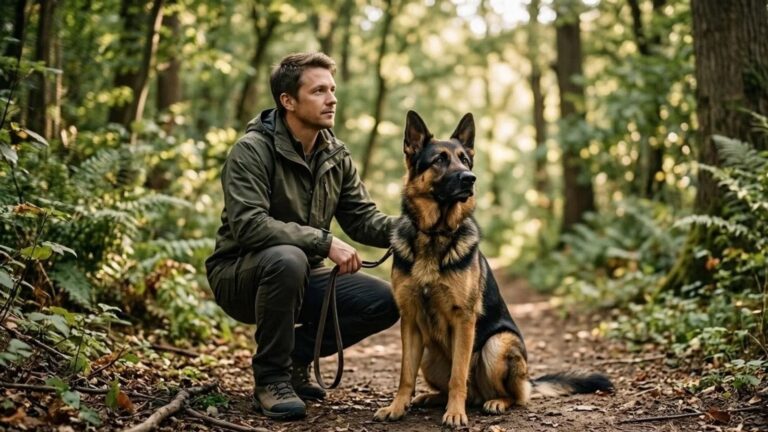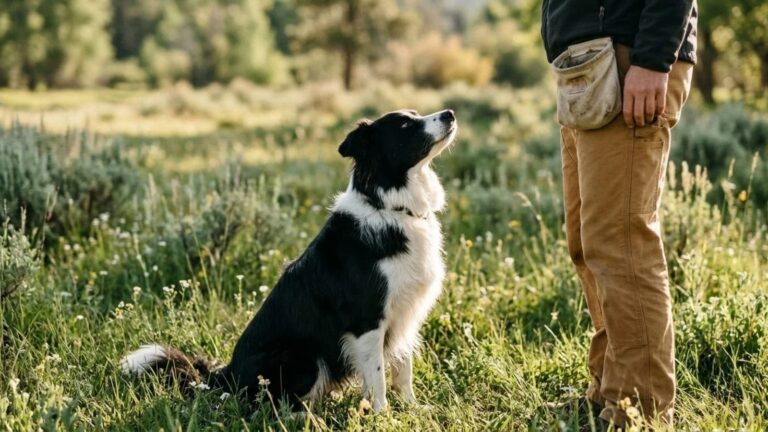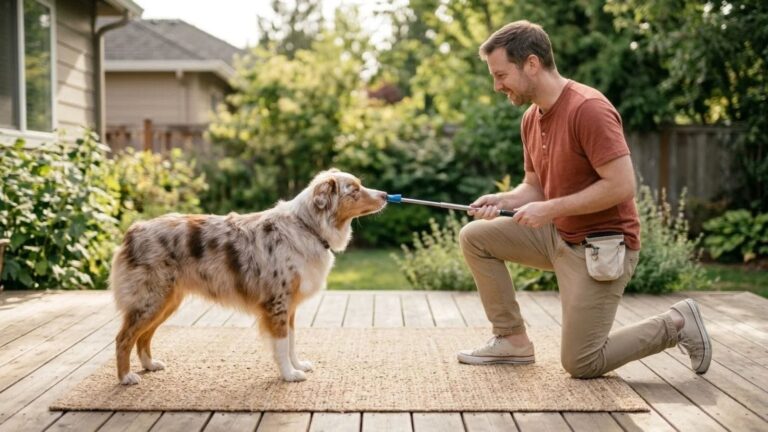
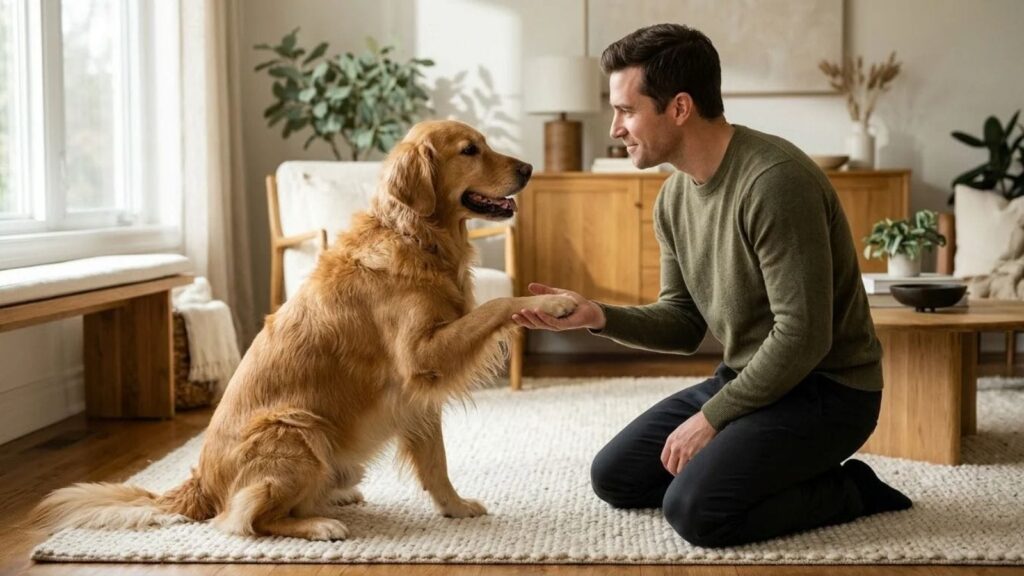
Teaching fun dog training tricks gives your dog an enjoyable way to use their brain, practise coordination and spend quality time with you. Beyond entertaining family and friends, simple tricks can encourage confidence, improve communication and provide a constructive activity for dogs that need more mental stimulation.
This guide covers 15 practical tricks, from a simple paw shake to putting toys in a basket. Each one includes clear teaching steps, reward-based methods and guidance on choosing movements that suit your dog’s physical comfort.
These activities are for enrichment, not a replacement for essential manners. If your dog needs help with sit, stay, recall or other everyday skills, start with our Dog Training Basics guide. For a deeper explanation of luring, shaping, progression and behavior chaining, see our Dog Training Tricks progression guide.
This article provides general educational information, not veterinary or individualized behavior advice.
Key Takeaways
- Reward-based teaching helps dogs learn playful behaviors without physical force or intimidation.
- Short sessions of three to five minutes can keep practice enjoyable and reduce frustration.
- Use secure, non-slip surfaces and choose movements that suit your dog’s age, health and physical ability.
- Treats should make up no more than 10% of your dog’s daily calorie intake, including rewards used during training.
- Start with one new trick at a time, then practise familiar behaviors in different suitable settings.
How to Teach Fun Dog Training Tricks Safely and Effectively
The most useful way to teach a new trick is to divide it into small steps your dog can understand. Reward the movement you want, repeat it while your dog remains comfortable and gradually introduce a consistent cue.
You can use a clicker or a short marker word such as “yes.” A marker identifies the moment your dog performs the desired action. Give the reward promptly after marking so your dog can connect the action with the outcome. The marker does not need to be followed by a treat within a rigid two-second deadline, but avoid long, confusing delays.
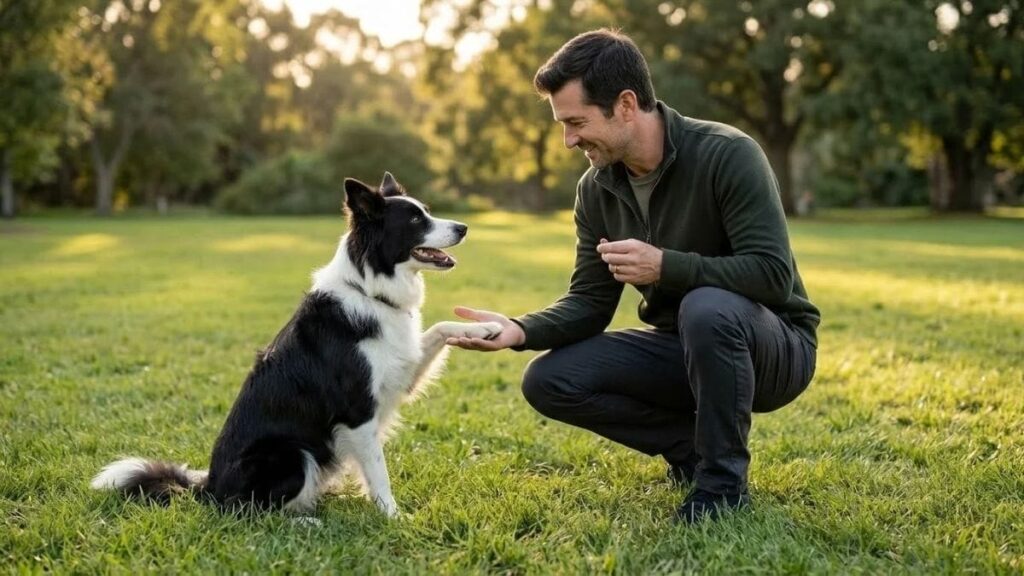
Three useful reward-based teaching methods are:
- Luring: Guide your dog’s nose with a small treat to encourage a movement. Once your dog understands the movement, gradually replace the food lure with an empty-hand signal.
- Capturing: Wait for your dog to perform a natural behavior, such as stretching or offering a paw. Mark and reward it when it happens.
- Shaping: Reward small steps toward the finished behavior. For example, reward your dog for looking at a basket, approaching it, touching it and eventually placing a toy inside.
Never push your dog’s limbs, pull their body into position or force them to complete a movement. If your dog repeatedly turns away, freezes, pants heavily in a cool room, shows tension or stops accepting rewards, pause and make the next attempt easier. Stop if you notice pain, limping or unusual movement.
For more detail on the mechanics behind these methods, see our Dog Training Tricks progression guide.
Choose a Safe Training Space
Practise on a secure, non-slip surface such as a firmly positioned rubber mat, stable carpet or suitable grass. Avoid slick floors, loose mats that can slide or curl, unstable furniture and raised platforms that could tip.
Keep sessions short and finish while your dog is still interested. A few successful repetitions are more useful than repeating a movement until your dog becomes tired or frustrated. Give your dog breaks between sessions and allow time to rest.
Match Tricks to Your Dog’s Physical Ability
Not every trick suits every dog. Puppies are still developing coordination and skeletal maturity, while senior dogs may have reduced balance, strength or joint comfort. Dogs with back, joint, respiratory or neurological conditions may need different activities.
Avoid demanding balance, jumping, repeated twisting or sustained awkward positions unless your veterinarian has confirmed that the activity is suitable. Long-backed dogs, including Dachshunds and some Corgis, may need particular care with spinal-loading movements. Brachycephalic dogs can overheat or struggle with strenuous activity, so keep sessions gentle and cool.
Keep Training Rewards Within the Daily Food Allowance
Use tiny, soft treats that your dog can eat comfortably without interrupting the session. Treats should make up no more than 10% of daily calories. Account for all training rewards, snacks and chews, not just the treats used during one session.
You can also use a portion of your dog’s measured daily food as rewards if it is suitable for training. Dogs on veterinary-prescribed diets, with food allergies or with medical conditions may need a specific reward plan. Ask your veterinary team if you are unsure which treats are appropriate.
The WSAVA guide to feeding treats to dogs explains the calorie allowance and highlights treat-safety considerations.
15 Fun Dog Training Tricks: Step-by-Step Instructions
The following tricks are grouped by the type of movement involved. Begin with simple paw and nose behaviors before trying activities that require more coordination or object interaction.
Choose tricks that suit your dog’s comfort rather than following the list as a difficulty ladder. A dog that enjoys a simple chin rest may find it more rewarding than a physically demanding movement.
Easy Beginner Party Tricks
1. Shake Paw
What your dog learns: To place one front paw gently in your open hand.
- Ask your dog to sit on a non-slip surface if sitting is comfortable.
- Hold a small treat inside a closed fist near your dog’s chest, without pressing it against their body.
- Wait quietly. When your dog lifts a paw toward your hand, mark the movement and reward.
- Repeat until your dog begins offering the paw more readily.
- Present your open palm and introduce a cue such as “paw” just before the movement.
Reward a gentle paw touch rather than grabbing or lifting your dog’s leg. If your dog does not naturally offer a paw, try capturing a small paw movement during a relaxed moment or teach a nose target first.
2. High Five
What your dog learns: To touch your upright palm with a front paw.
- Begin after your dog understands the paw-touch behavior.
- Hold your open palm vertically at a comfortable height near your dog’s chest.
- Wait for your dog to touch your hand with a paw.
- Mark the contact and reward from your other hand.
- Add a separate cue such as “high five” once your dog can distinguish the upright palm from the lower shake-hand position.
Keep your palm low enough that your dog does not need to jump or stretch uncomfortably. Do not pull the paw upward to create the movement.
3. Spin Left and Twist Right
What your dog learns: To make a controlled circle in either direction.
- Start with your dog standing comfortably on a non-slip surface.
- Hold a treat near your dog’s nose and guide it through a small, flat circle to the left.
- Mark and reward when your dog completes the turn without jumping or losing balance.
- Repeat in the opposite direction using a different cue, such as “twist.”
- Practise each direction separately before alternating between the two.
Keep the circles slow and comfortable. Do not repeatedly spin a dog that appears dizzy, unsteady or reluctant. Dogs with balance problems, spinal discomfort or mobility limitations should practise a different trick.
4. Speak and Whisper
What your dog learns: To offer a vocalization on cue and distinguish a louder sound from a softer one.
- Begin only if your dog already vocalizes naturally and remains relaxed during the activity.
- Observe a brief, voluntary bark during ordinary play or an everyday interaction.
- Mark one bark and reward. Avoid exciting your dog into repeated barking.
- Once the behavior is predictable, introduce a cue such as “speak” just before a likely bark.
- For “whisper,” capture a naturally occurring soft huff or quiet vocalization and reward that specific sound.
Teach a reliable quiet or stop cue separately if barking is becoming excessive. Do not knock on walls, frighten your dog or use startling sounds to provoke barking. If your dog barks because of fear, distress or frustration, address the cause rather than turning it into a trick.
5. Kiss: Hand-Target Version
What your dog learns: To touch a hand gently with their nose.
- Hold a flat palm a short distance from your dog’s nose.
- When your dog investigates or gently touches your hand, mark and reward.
- Repeat until your dog deliberately moves toward your palm.
- Add a cue such as “touch” or “kiss” just before presenting your hand.
- Gradually move your palm to different comfortable positions while keeping the movement voluntary.
A hand target is the safer default. Avoid encouraging dogs to touch their nose or mouth to a person’s face, particularly around children, unfamiliar people or anyone who is uncomfortable with close contact. Do not reward licking, mouthing or jumping toward the face.
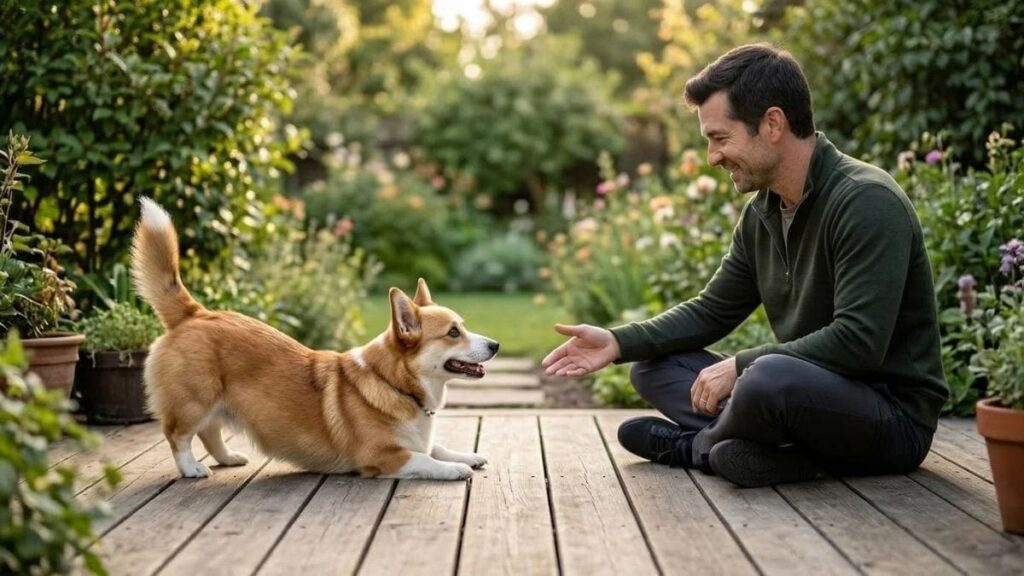
Playful Body-Awareness and Movement Tricks
6. Take a Bow
What your dog learns: To lower the front of the body while keeping the hindquarters raised.
- Start with your dog standing naturally on a non-slip surface.
- Hold a treat near the nose and slowly guide it down toward the space between the front paws.
- Watch for the elbows beginning to bend while the hindquarters remain standing.
- Mark that partial bow and reward before your dog moves into a full down.
- Repeat small, comfortable movements and introduce a cue such as “bow” once the action is predictable.
Do not push the shoulders down or hold the rear of the body in place. If your dog repeatedly lies down instead, reward a smaller front-end movement rather than forcing a deeper stretch.
7. Roll Over
What your dog learns: To roll from a comfortable down position onto the side and, if physically suitable, through a full roll.
- Begin with your dog lying comfortably on a padded, non-slip surface.
- Move a treat slowly toward one shoulder so your dog turns their head and shifts their weight.
- Mark and reward the first comfortable movement onto the hip or side.
- If your dog remains relaxed, gradually reward a little more rotation over separate repetitions.
- Add a cue such as “roll over” only after the movement is comfortable and predictable.
Do not pull your dog’s legs, push their back or try to turn them over by force. A full roll is not appropriate for every dog. Skip it if your dog has a history of back or joint problems, shows stiffness, resists lying on one side or appears uncomfortable. Ask your veterinarian before practising if you have any concerns.
8. Play Dead
What your dog learns: To lie calmly on one side after a cue.
- Start with a comfortable down on a padded surface.
- Present a treat near your dog’s nose and move it gently toward one shoulder.
- Reward a small head turn or natural shift of weight.
- Gradually reward your dog for resting on one side, without pushing their hips or shoulders.
- Introduce a cue such as “sleep” or “bang” when the side-lying position becomes predictable.
This trick does not require a complete roll. Keep the position brief and allow your dog to stand whenever they want. Avoid it if lying on the side causes discomfort or if your dog has mobility or spinal problems.
9. Crawl
What your dog learns: To move forward a short distance while remaining low to the ground.
- Ask your dog to lie down on a secure, padded surface.
- Hold a treat close to the floor just ahead of the nose.
- Move it forward by a very small distance.
- Mark and reward if your dog naturally shifts forward without standing.
- Build the distance gradually, keeping each movement short and comfortable.
Do not pull your dog forward by the collar or encourage prolonged dragging. Crawling can place demands on the shoulders, elbows, back and core. Skip this trick for dogs with joint pain, spinal conditions, mobility limitations or any sign of discomfort.
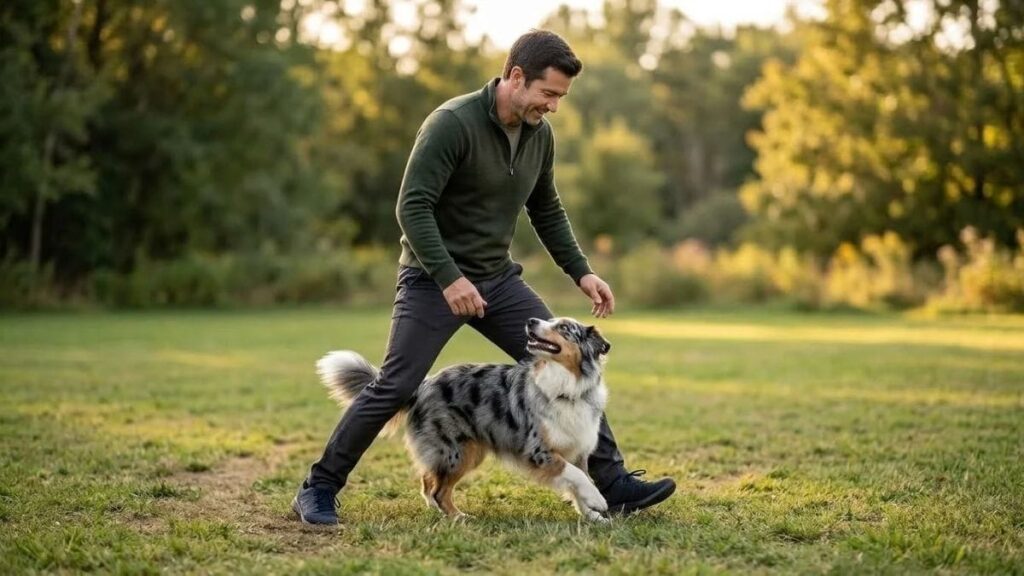
10. Leg Weave
What your dog learns: To move in a figure-eight pattern through the handler’s legs.
- Stand with your feet comfortably apart on a non-slip surface.
- Begin with your dog beside you and guide them slowly through the space between your legs.
- Reward the first successful pass rather than expecting a complete figure eight immediately.
- Use the other hand to guide your dog around the opposite leg and through again.
- Gradually link the two passes and introduce a cue such as “weave.”
Keep your stance wide and stable. Move slowly and avoid stepping over your dog. Once your dog understands the pattern, practise with larger, deliberate steps before attempting a walking weave. Skip this trick if bending between the legs or turning causes discomfort.
Impressive Prop and Household Helper Tricks
11. Paws Up
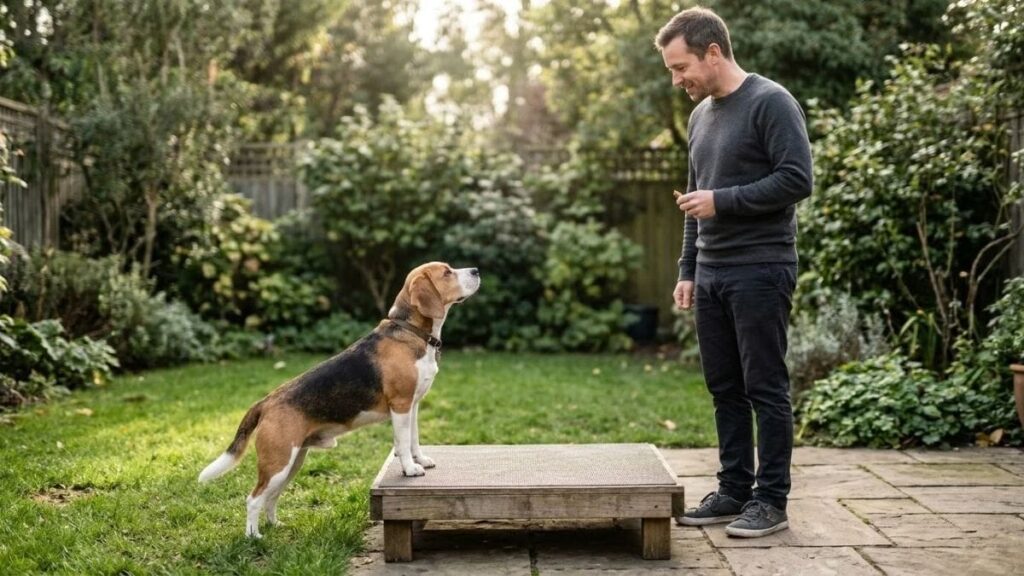
What your dog learns: To place both front paws on a low, stable platform while keeping the back paws on the floor.
- Choose a broad, low platform with a non-slip top. Place it on a secure floor or rug.
- Let your dog investigate it without pressure.
- Mark and reward any voluntary paw contact with the platform.
- Gradually reward placing one paw and then both front paws on the surface.
- Introduce a cue such as “paws up” once the position is reliable.
Keep the platform low enough for your dog to step onto comfortably. Do not use stools, unstable boxes or slippery surfaces. The dog should be able to step away freely.
12. Chin Rest
What your dog learns: To rest their chin gently on a hand or soft support.
- Sit comfortably and hold one palm open at a height your dog can reach without stretching.
- Wait for your dog to investigate or lower their chin toward your hand.
- Mark and reward the moment the chin makes contact.
- Repeat until your dog deliberately places their chin on your palm.
- Gradually increase the duration by a second at a time, rewarding calm contact.
You can later transfer the behavior to a folded towel or another comfortable support. This can help introduce cooperative-care exercises, but never use the chin rest to restrain your dog. Your dog should always be free to lift their head and move away.
13. Peekaboo: Middle Between the Legs
What your dog learns: To stand calmly between the handler’s legs and look forward.
- Stand with your feet comfortably apart and keep your balance.
- With your dog behind you, use a treat to encourage them to move through the space between your legs.
- Mark and reward when your dog reaches the middle position.
- Repeat until your dog can enter the position without following a visible treat.
- Add a cue such as “middle” or “peekaboo.”
Keep your legs stationary while your dog moves through. Do not close your stance around the dog or use the position to trap them. Choose a different trick if your dog is uncomfortable in confined spaces or if their size makes the position awkward or unsafe.
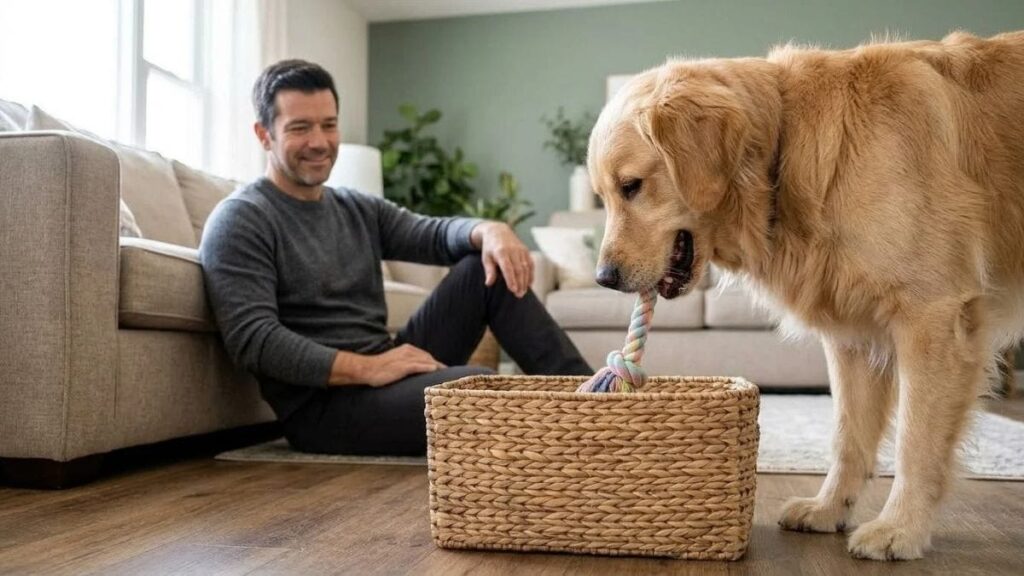
14. Tidy Up Toys
What your dog learns: To place a familiar toy into a basket.
- Choose a soft, safe toy your dog already knows how to pick up and release.
- Place a wide, low basket close to your dog.
- Begin by rewarding your dog for carrying the toy toward the basket.
- Hold the basket beneath the toy and reward a release that lands inside.
- Gradually place the basket on the floor and reward successful drops into it.
- Introduce a cue such as “tidy up” once your dog understands the action.
Use a basket with a stable base and an opening large enough for easy access. Start with one toy and add others only when your dog understands the task. Do not use objects that can splinter, break or be swallowed. If your dog guards toys or becomes distressed when asked to release them, work on that issue separately with suitable professional guidance.
15. Wave
What your dog learns: To lift one front paw in a small waving motion.
- Begin with your dog standing or sitting comfortably on a non-slip surface.
- If your dog already offers a paw for a shake, wait for a small paw lift without presenting your hand.
- Mark and reward the lift before your dog needs to reach or stretch.
- Repeat, gradually rewarding a slightly higher or more deliberate lift.
- Add a cue such as “wave” and a small hand signal once the behavior is predictable.
If your dog does not naturally offer a paw, capture a small movement during a relaxed moment rather than pulling the leg upward. Keep the paw lift low and comfortable. This is a lower-impact alternative to balancing upright on the hind legs, although it may still be unsuitable for dogs with shoulder, elbow or other limb problems.
Quick Comparison of the 15 Fun Dog Training Tricks
Use this table to compare the movements and choose a trick that matches your dog’s experience and physical comfort. Difficulty is a general guide, not a fixed assessment of every dog.
| Trick | General difficulty | Main teaching approach | Physical considerations |
| Shake Paw | Beginner | Capturing or gentle hand target | Low impact; avoid lifting or pulling the paw |
| High Five | Beginner | Paw-touch transfer | Keep the palm at a comfortable height |
| Spin Left and Twist Right | Beginner | Nose lure, then empty hand signal | Avoid repeated turns or twisting in dogs with mobility issues |
| Speak and Whisper | Beginner | Capturing voluntary vocalizations | No physical demand; avoid provoking distress or excessive barking |
| Kiss: Hand Target | Beginner | Nose targeting | Low impact; use a hand target rather than face contact |
| Take a Bow | Beginner to intermediate | Gradual lure or shaping | Requires comfortable shoulder and front-leg movement |
| Roll Over | Intermediate | Small weight shifts and gradual shaping | Avoid with spinal, joint or balance concerns |
| Play Dead | Beginner to intermediate | Side-lying shaping | Use a padded surface and allow the dog to move freely |
| Crawl | Intermediate | Short forward shaping from a down | Can load shoulders, elbows and core |
| Leg Weave | Intermediate | Alternating hand target or lure | Requires comfortable turning and handler coordination |
| Paws Up | Beginner | Shaping onto a low platform | Platform must be broad, stable and non-slip |
| Chin Rest | Beginner | Nose or chin targeting | Low impact; never use it to restrain the dog |
| Peekaboo | Intermediate | Luring through a wide leg gap | Requires comfortable movement through the handler’s legs |
| Tidy Up Toys | Intermediate to advanced | Retrieve, target and release | Low physical demand; requires safe objects and release skills |
| Wave | Beginner | Capturing and shaping a paw lift | Keep the movement small and comfortable |
How to Fade the Food Lure and Practise Tricks in New Places
A dog that follows a treat in your hand has started learning the movement, but the visible food should not have to guide every repetition. The goal is to make the hand movement or verbal cue meaningful while keeping rewards available after successful attempts.
The American Kennel Club’s guidance on fading food lures explains how to replace a food lure with a hand signal without removing the reward.
Step 1: Separate the Lure From the Reward
First, guide the movement with food if your dog needs it. Then begin delivering the reward from your other hand or a treat pouch. This helps your dog learn that following the guiding hand, rather than seeing food in it, produces the behavior.
Step 2: Use an Empty Hand
Repeat the familiar guiding gesture without food in that hand. Mark and reward the completed movement from your pouch or other hand. If your dog hesitates, make the gesture easier or briefly return to the previous step.
Step 3: Make the Signal Smaller
Gradually reduce the size of the hand movement. A large circular lure for a spin, for example, can become a smaller hand signal as your dog understands the behavior.
Step 4: Add a Verbal Cue
Once your dog responds consistently to the hand signal, say the chosen word first, pause briefly and then give the familiar gesture. Reward the response. Over time, reduce the gesture if you want the dog to respond more reliably to the spoken cue.
Do not rush this process. Some tricks are harder to perform without a lure, and some dogs need more practice than others. Continue rewarding successful responses even after the food is no longer visible in your guiding hand.
Practise in Different Suitable Settings
A trick learned in the living room may not be reliable in the garden or another room. Once your dog can perform it comfortably in a quiet place, practise in another familiar setting with fewer distractions.
Introduce only one change at a time. For example, change the room before adding a person nearby. If your dog struggles, return to an easier setting and rebuild confidence. Outdoors, use a secure area and a suitable harness and leash where needed.
A Seven-Day Trick Practice Planner
This plan is designed to teach one selected trick over seven days, not to introduce a different new trick every day. Choose a behavior that suits your dog’s ability and adjust the schedule if your dog needs more time.
Each session should last around three to five minutes. The suggested repetitions are starting points, not quotas. Stop sooner if your dog becomes tired, frustrated or uncomfortable.
| Day | Session 1 | Session 2 |
| Day 1: Explore the movement | Let your dog investigate the target, prop or hand position. Reward one or two small steps toward the trick. | Repeat the easiest successful movement and finish with a familiar, enjoyable behavior. |
| Day 2: Build the first step | Practise the same movement with a lure or target if needed. Reward each comfortable attempt. | Repeat the movement and make only a small increase in the criterion if your dog is ready. |
| Day 3: Improve consistency | Practise the same action with a clear marker and prompt reward. | Repeat in the same quiet setting. If your dog struggles, return to an easier step. |
| Day 4: Introduce a cue | Say the chosen cue just before the familiar hand signal or target presentation. | Repeat a few cue-and-action attempts, rewarding successful responses. |
| Day 5: Fade assistance | Try the familiar movement with an empty guiding hand or a smaller target. | Alternate an easier repetition with a successful independent attempt. |
| Day 6: Change one setting | Practise in another familiar, quiet room or suitable outdoor space. Make the task easier if the new setting is distracting. | Repeat in that setting without adding extra difficulty. |
| Day 7: Review and rest | Take a break from formal training. Notice whether your dog offers the behavior naturally and comfortably. | If your dog is relaxed and interested, finish with a short review. Otherwise, rest and continue another day. |
Do not add a second trick simply because the seven days have passed. Some behaviors take longer to learn, and there is no need to rush. Once the first trick is comfortable and predictable, you can begin teaching another one.
What to Do When Trick Training Gets Difficult
A training plateau does not mean your dog is stubborn or incapable. It often means the task is unclear, the reward is not motivating enough or the current step is too difficult.
| What you notice | Possible reason | What to try |
| Your dog walks away or stops participating | The session may be too long, the step too difficult or the dog tired | Pause, make the next attempt easier or end the session |
| Your dog keeps offering several tricks | The cue may not be clear, or the dog is excited by the reward | Pause calmly, then ask for one familiar, easy behavior |
| Your dog follows food but ignores the empty hand | The lure has not been faded gradually | Return to an easier hand movement and reward from the other hand |
| Your dog barks or paws repeatedly | Excitement, frustration or confusion may be increasing | Reduce the difficulty, lower the excitement and reward a calm, simple response |
| Your dog drops a toy before reaching the basket | Carrying and releasing have not been taught as separate steps | Practise a short carry and a gentle release before combining them |
| Your dog avoids a movement or appears stiff | The trick may be uncomfortable or physically unsuitable | Stop the exercise; seek veterinary advice if discomfort persists or is suspected |
If your dog shows repeated fear, frustration, guarding, sudden behavior changes or difficulty with ordinary movement, do not try to solve the problem by drilling the trick. A veterinarian or qualified reward-based behavior professional can help identify the right next step.
FAQs
What are the easiest fun dog training tricks to teach first?
Shake paw, high five, chin rest, a hand-target touch and a small wave are useful starting points for many dogs. They involve simple movements and can be taught in short sessions. The easiest choice depends on your dog’s comfort, coordination and willingness to participate.
Can puppies and senior dogs learn fun dog training tricks?
Yes. Dogs at different life stages can enjoy gentle, low-impact training, but the activities should match their physical development and health. Puppies benefit from simple targeting and short, positive sessions. Senior dogs may enjoy chin rests, nose targets and scent games. Avoid demanding balance, jumping or twisting movements when they are not suitable. Ask your veterinarian if your dog has a health or mobility concern.
How many tricks should I teach my dog at one time?
For a new behavior, focus on one trick until your dog understands its basic movement and cue. You can continue practising familiar tricks for enjoyment, but introducing several similar new hand signals at once may make learning less clear. Move at your dog’s pace rather than following a fixed deadline.
What should I do if my dog gets frustrated during trick training?
Pause and make the exercise easier. Reward a smaller step, offer a familiar behavior or end the session if your dog is no longer interested. Avoid repeating the cue or physically guiding your dog into position. If frustration happens frequently, review the task and consider help from a qualified reward-based trainer.
How do I stop my dog from offering every trick to get a treat?
Use a clear cue before asking for a behavior and reward the action you requested. If your dog starts offering several movements, pause briefly without scolding, then give a simple cue your dog already understands. Keep treats out of sight until it is time to reward. This helps separate the cue from the dog’s habit of guessing.
Conclusion
Fun dog training tricks can turn a few minutes at home into an enjoyable activity that encourages communication, confidence and mental engagement. Start with a simple movement, reward small successes and choose exercises that respect your dog’s physical comfort.
You do not need to teach all 15 tricks or follow a strict timetable. One well-understood behavior is more valuable than several movements your dog performs reluctantly. If your dog enjoys learning, choose another suitable trick when the first one becomes familiar.
For more advanced guidance on luring, shaping, cue control and combining behaviors, continue with our Dog Training Tricks progression guide. For everyday manners and foundational commands, visit our Dog Training Basics guide.