Dog training tricks involve more than teaching a collection of party commands. With a thoughtful approach, trick training helps dogs solve problems, explore movement, respond to cues and build communication with their owners. A simple nose touch, for example, can become the foundation for more involved behaviours and connected routines.
The best way to develop these skills is through gradual progression. Teach one behaviour at a time, reward useful attempts and make sure your dog understands each step before adding another. This guide covers four practical teaching methods: luring, capturing, targeting and free-shaping, along with behaviour chaining, cue reliability and physical safety.
For step-by-step instructions covering 15 specific behaviours, see our [fun dog training tricks guide]. If your dog is still learning everyday manners and essential commands, start with our [dog training basics guide]. This article provides general educational information, not veterinary or individualised behaviour advice.
Key Takeaways
- Reward-based trick training gives dogs opportunities to practise problem-solving, communication and voluntary movement.
- Luring, capturing, targeting and free-shaping offer different ways to teach new behaviours.
- More complicated routines should be built from individual actions the dog already understands.
- Reliable cues develop through consistent practice and gradual exposure to different environments.
- Training activities should match the dog’s age, comfort, physical condition and willingness to participate.
The Science of Dog Training Tricks: Four Core Teaching Mechanics
Effective trick training uses learning principles to help a dog understand which behaviour earns a reward. A marker, such as a clicker or a consistent verbal word, can identify the moment the dog performs the desired action. The reward then follows promptly.
For example, if you are teaching a dog to touch a target with its nose, mark the instant its nose makes contact. Give the reward immediately afterwards. The marker helps identify the successful action, while the reward gives the dog a reason to repeat it.
The American Veterinary Society of Animal Behavior recommends reward-based methods for dog training. Its position statement on humane dog training explains why training should avoid methods that rely on force, pain or intimidation.
Skilled handlers do not use one teaching method for every behaviour. They select an approach based on the movement, the dog’s experience and the result they want to teach.
| Teaching method | How it works | Useful applications | What to work on next |
| Luring | A treat or toy guides the dog’s nose and body towards a position or movement | Initial body positions, turns and simple movement patterns | Gradually remove the visible food and practise the same movement with an empty-hand signal |
| Capturing | The handler waits for a naturally occurring behaviour, marks it and rewards it | Spontaneous stretches, play bows and other naturally offered actions | Once the dog offers the behaviour more consistently, introduce a cue |
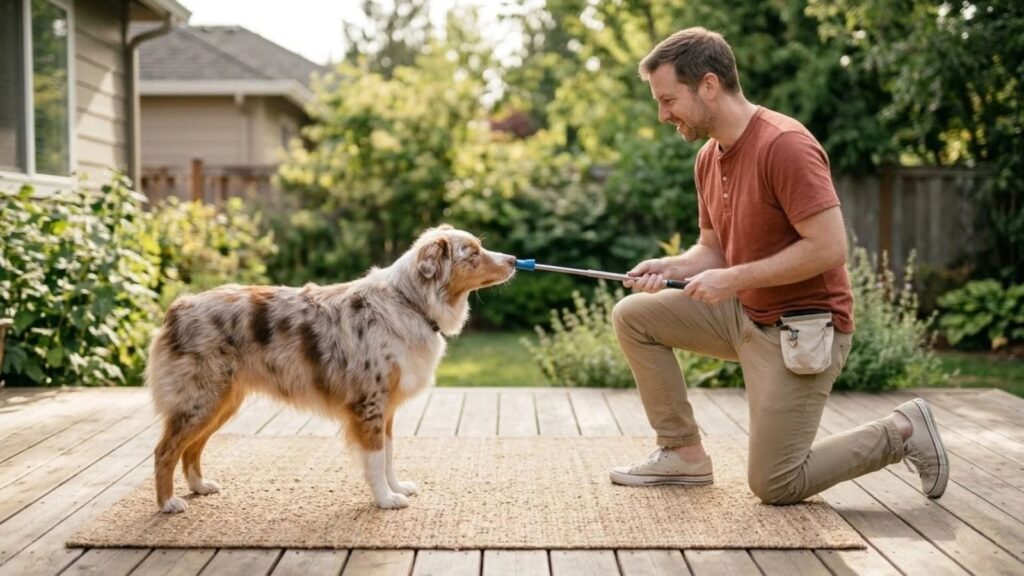
| Targeting | The dog learns to touch or rest a body part on a particular object | Nose touches, paw targets, stationing and cooperative-care exercises | Gradually transfer the behaviour to the intended object or location |
| Free-shaping | The handler rewards small steps that gradually approach the final behaviour | Independent problem-solving and interactions with training props | Increase the difficulty gradually while keeping the dog engaged and successful |
1. Luring: Guide the First Movement
Luring is often a convenient way to introduce a new movement. Hold a small treat near the dog’s nose and move it slowly in the direction you want the dog to follow.
For example, moving a treat in a gentle curve can encourage a dog to turn. Raising it slightly may encourage the dog to shift its head and body into a different position.
The important next step is to fade the lure. Once your dog understands the movement, repeat it with an empty hand using a similar gesture. Reward from your other hand or a treat pouch rather than keeping food in the guiding hand.
Do not rely on a fixed number of repetitions. Some dogs understand a movement quickly, while others need more practice. Reduce the lure when the dog is responding comfortably and consistently.
2. Capturing: Reward Behaviours Your Dog Offers Naturally
Capturing is useful when a dog already performs a behaviour without being asked. You simply notice the action, mark it and reward it.
Imagine your dog stretching after a nap. If the stretch resembles the beginning of a bow, you can mark the movement and reward it. With consistent opportunities, the dog may begin offering that action more often.
Capturing is different from waiting indefinitely for a behaviour. Keep sessions relaxed, reward useful attempts and avoid creating frustration by repeatedly withholding reinforcement.
Once the dog offers the behaviour reliably, introduce a verbal cue immediately before you expect it to happen. Practise the cue in easy situations before adding distractions.
3. Targeting: Give Your Dog a Clear Point of Contact
Targeting teaches a dog to touch or rest a specific body part on an object. A flat hand can become a nose target, while a small, stable mat can serve as a stationing target.
Start with a simple object. Present it close to your dog and mark a voluntary investigation or touch. Reward the contact. As your dog understands the exercise, gradually move the target or place it in a different position.
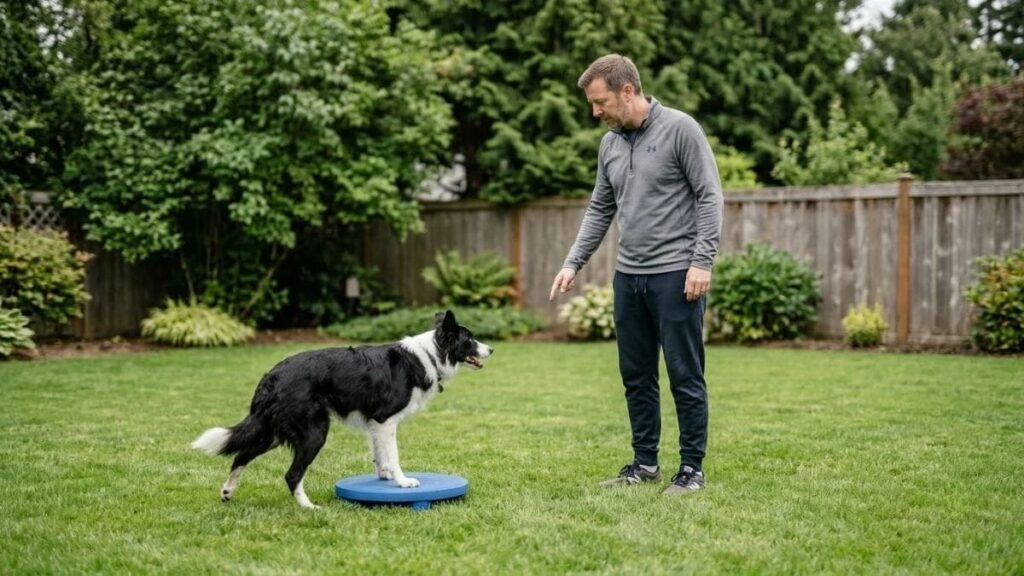
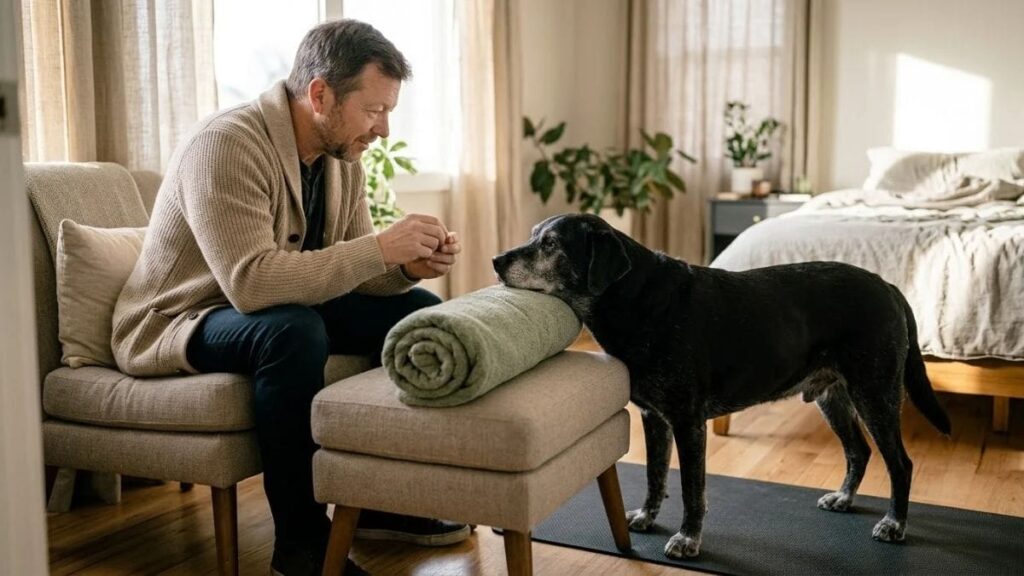
Targeting can later support more involved activities, such as moving towards a platform, touching a prop or resting the chin on a towel. Keep objects stable and comfortable, and never force a dog’s body onto a target.
4. Free-Shaping: Build a Behaviour in Small Steps
Free-shaping rewards successive approximations: small actions that move towards a final goal.
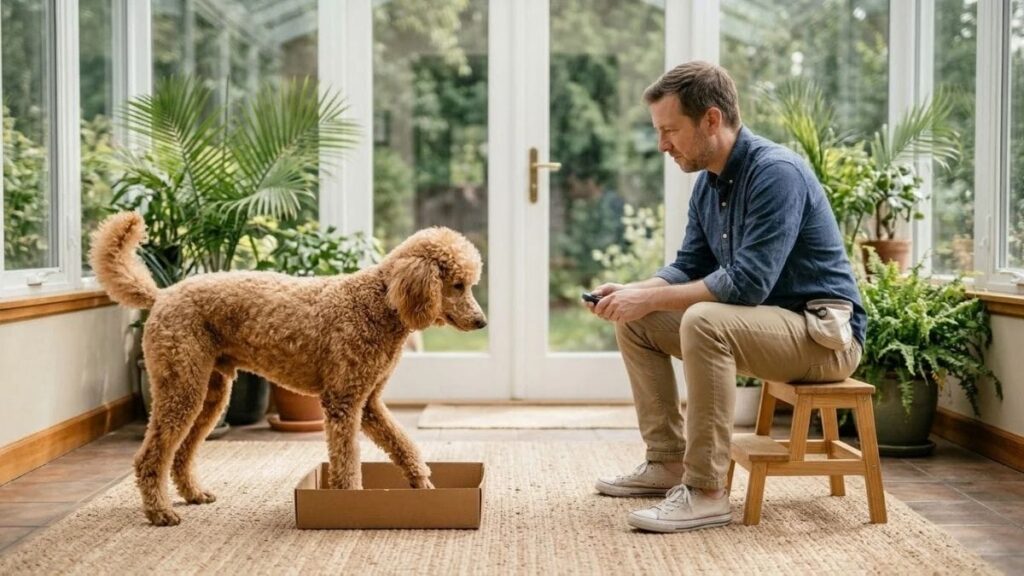
Suppose you want your dog to step into a low cardboard box. You might first reward looking at the box, then approaching it, sniffing it and eventually placing one paw inside. Later, you can reward additional paw placements until the dog understands the complete action.
The handler decides which small improvement to reward. If the dog becomes confused, return to an easier step rather than repeating the same difficult request.
There is no universal click rate or required number of rewards per minute. The right pace depends on the dog, the exercise and how easily the dog can understand the next step.
Transferring Value from Lures to Targets and Shaping
Luring can help a dog understand a movement, but it should not become a permanent requirement. If the dog only follows food held in front of its nose, it may wait for the treat instead of responding to the cue.
A gradual transition helps develop more independent responses:
- Introduce the movement: Use a food lure or simple hand movement if it helps your dog understand the action.
- Repeat without visible food: Make the same hand movement with an empty hand and reward from the other hand or a pouch.
- Add a consistent cue: Introduce a verbal cue when the dog is beginning to understand the behaviour.
- Practise the cue without the lure: Give the cue once and allow the dog time to respond.
- Reward successful attempts: Continue rewarding the behaviour while gradually varying the reward schedule as reliability improves.
A target can also help transfer a behaviour from a hand-guided movement to a specific object. For example, a dog that understands a nose touch to a hand may learn to touch a target stick.
Keep training rewards small and include them in your dog’s daily food allowance. The WSAVA guide to feeding treats recommends that treats make up less than 10% of a dog’s daily calorie intake. Some dogs may need a lower allowance, particularly if they have a medical condition or are on a prescribed diet. You can also use part of your dog’s measured daily food ration as training rewards when appropriate.
The Five Levels of the AKC Trick Dog Programme
A progression framework can help handlers organise training goals, but it is important to distinguish a personal training roadmap from an official title programme.
The American Kennel Club recognises five Trick Dog titles: Novice, Intermediate, Advanced, Trick Dog Performer and Trick Dog Elite Performer. Each has its own requirements and checklist. The requirements are not simply a universal set of physical or cognitive milestones.
The official AKC Trick Dog programme explains the title sequence and evaluation process. The following table describes the general training focus that handlers may use when preparing for each level. It is not a substitute for the current official checklist.
| AKC title level | General training focus | A useful preparation goal |
| Novice (TKN) | Introducing a range of simple behaviours and learning to respond to cues | Build a foundation of easy, comfortable behaviours and practise them in a quiet setting |
| Intermediate (TKI) | Developing a broader range of skills and reducing reliance on food lures | Practise familiar behaviours with clearer cues and more independent responses |
| Advanced (TKA) | Expanding the range and difficulty of individual behaviours | Improve consistency, introduce suitable props and practise more involved actions |
| Trick Dog Performer (TKP) | Presenting learned tricks in a short routine | Connect familiar behaviours into a clear sequence and include the required prop-based skills |
| Trick Dog Elite Performer (TKE) | Presenting a themed or story-based routine using multiple props | Plan a coherent performance with behaviours the dog already understands |
The AKC describes specific requirements for each title. For example, Novice involves performing 10 skills from the Novice list, while Intermediate and Advanced build on previously earned titles and their respective trick lists. Performer and Elite Performer involve routines, with prop and story requirements. Always check the current AKC application and evaluator checklist before preparing for an assessment.
Dogs need not be purebred to participate. The AKC programme accepts eligible dogs with an AKC registration, Purebred Alternative Listing or Canine Partners number. Evaluations can be arranged in person or virtually through an approved evaluator.
Progress at the Dog’s Pace
A dog does not need to pursue official titles to benefit from trick training. Some dogs enjoy learning a wide variety of simple actions, while others prefer a small number of familiar activities.
Use the levels as a way to organise your own goals, not as a reason to rush. A dog that performs a simple behaviour comfortably and willingly is making progress, even if it never enters a formal evaluation.
How to Build Multi-Step Behaviour Chains
Once a dog understands individual behaviours, you can begin connecting them into a sequence. This is known as behaviour chaining.
Imagine a routine in which a dog approaches a basket, picks up a toy, carries it to a container and drops it inside. Each action is a separate behaviour. The dog needs to understand the individual steps before the complete routine can become reliable.
Trying to teach the entire sequence at once can make it difficult to identify where the dog becomes confused. Instead, work on the individual actions and then practise short connections between them.
Forward Chaining
Forward chaining teaches the sequence in its natural order.
For a three-step routine:
- Step A: Walk towards a basket.
- Step B: Pick up a toy.
- Step C: Place the toy inside the basket.
You first teach Step A, then connect A to B, and finally add C. This can be intuitive for the handler because the routine develops in the same order the dog will perform it.
Back-Chaining
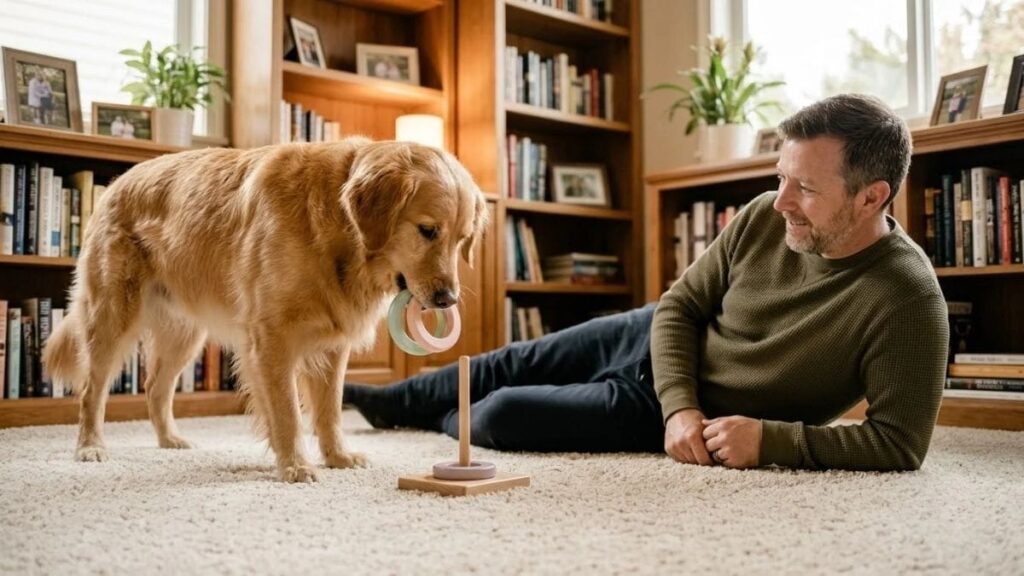
Back-chaining starts with the final behaviour and adds earlier actions in reverse order. It can be useful when the final action is clear and rewarding, such as dropping a ring onto a peg or placing a toy into a basket.
For the same three-step routine:
- Teach the final action: First, help your dog understand how to place the toy inside the basket. Reward the successful placement.
- Add the preceding action: Practise picking up the toy and moving it towards the basket before completing the familiar placement.
- Add the opening action: Introduce the approach to the toy or starting position, then connect it to the steps the dog already understands.
- Practise the complete sequence: Once each connection is comfortable, gradually ask for the full routine.
Back-chaining can give the dog a familiar final action to work towards. However, it is not automatically better than forward chaining. The most suitable approach depends on the behaviour, the dog’s experience and how easily the steps can be connected.
Reinforce the Transitions, Not Just the Final Performance
A dog may understand every individual action but still struggle when moving from one step to the next. If that happens, practise the difficult connection separately.
For example, if your dog picks up a ring but drops it before reaching the peg, simplify the distance or practise the carry separately. Reward progress before asking for the full routine again.
Use a consistent marker and reward system. You can also use verbal praise between steps when it helps maintain engagement, but make sure the dog understands which actions are part of the sequence.
Stimulus Control, Cue Discrimination and Generalisation
A behaviour is under stimulus control when a particular cue reliably signals when the dog should perform it. The dog responds to the intended cue, rather than offering the behaviour randomly or responding to an unrelated signal.
For example, if you teach separate cues for a left turn and a right turn, each cue should eventually produce its own movement. This requires consistent signals and practice in situations where the dog can concentrate.
Teach One Cue Clearly Before Adding Another
Start with one behaviour in a quiet, familiar environment. Give the cue once, allow your dog an opportunity to respond and reward the correct action.
When the dog understands the first behaviour, introduce a second cue. Practise them separately before asking the dog to distinguish between them.
Avoid changing several things at once. If you use a verbal cue, keep your body language consistent. If you use a hand signal, make it recognisably different from other signals.
Generalise Skills Gradually
Dogs do not automatically understand that a behaviour learned in the living room should work in a garden, park or unfamiliar building.
Introduce new environments gradually:
- Start in a familiar, quiet room.
- Practise in another part of the home.
- Move to a quiet outdoor area with suitable footing.
- Add mild distractions only when the dog is comfortable.
- Increase the difficulty gradually and return to an easier setting if the dog struggles.
Use a secure harness and lead where appropriate, particularly in unfamiliar outdoor locations. Do not practise off-leash tricks near roads, unfamiliar dogs or other hazards.
A dog that responds reliably at home may need extra support in a new environment. That is a normal part of learning, not evidence that the dog has forgotten the behaviour.
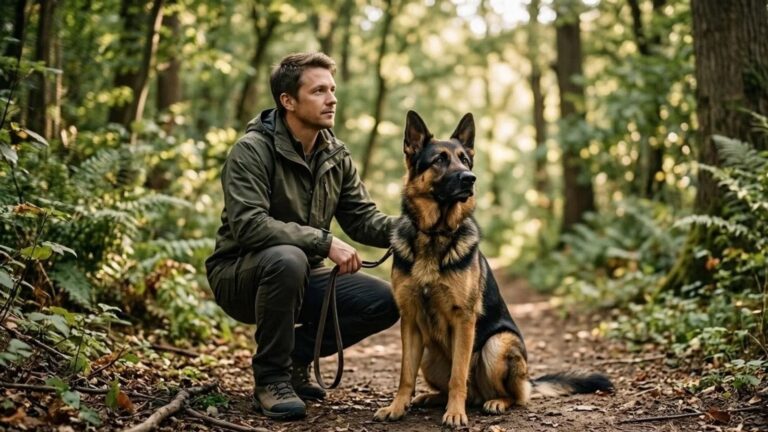
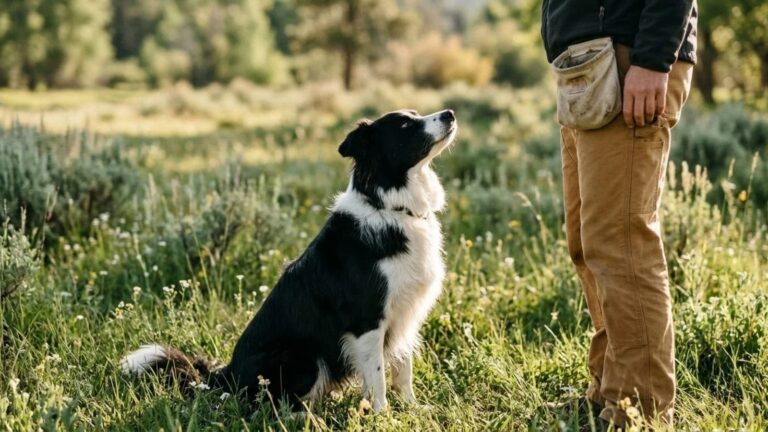
For breed-specific training considerations, see our Border Collie training guide and German Shepherd training guide.
Physical Conditioning, Proprioception and Life-Stage Safety
Trick training can involve different types of movement, from simple nose touches to more demanding actions that require balance, coordination or changes in body position.
Proprioception refers to the body’s awareness of its position and movement. Some training activities encourage dogs to place their paws carefully, move around an object or adjust their stance. These can provide opportunities to practise coordination, but they should not be presented as a substitute for rehabilitation or a guaranteed way to strengthen particular muscles.
Choose activities that suit your dog’s body and experience. A low, stable platform may be appropriate for one dog, while another may be more comfortable practising nose targets on the floor.
Growing Puppies
Puppies can begin learning simple, low-impact behaviours when sessions are gentle, positive and appropriate for their development. Nose touches, easy targeting games and calm interactions with familiar objects are useful starting points.
Avoid repeatedly asking a growing puppy to jump from heights, perform tight turns or repeat physically demanding movements. Growth and development vary between dogs, so there is no single age at which every puppy is ready for more demanding activities.
If you are considering jumping, agility-style exercises or repeated high-impact movements, ask your veterinarian for advice based on your puppy’s development and health. Our guide to how much exercise a puppy needs provides additional everyday exercise guidance.
Dogs with Long Backs or Brachycephalic Features
Dogs with different body shapes may have different physical limitations. Dachshunds and some other long-backed breeds may need particular care around repeated jumping, twisting or movements that place strain on the back.
Flat-faced breeds, including French Bulldogs and Pugs, may be less comfortable during strenuous activity or in warm conditions. Keep sessions calm, provide suitable ventilation and stop if the dog shows signs of breathing difficulty or overheating.
Do not assume that a trick is safe for every dog simply because it is easy for another breed. Adapt the movement or choose a different activity.
Senior Dogs and Dogs with Joint or Mobility Problems
Older dogs may still enjoy learning, but their comfort and mobility should guide the activity. Simple scent games, nose targets, gentle object interactions and chin rests can offer mental engagement without requiring jumping or complicated balance movements.
Use a stable, non-slip surface and allow the dog to change position freely. If your dog has arthritis, spinal disease, a previous injury or a change in movement, ask your veterinarian which activities are appropriate.
A dog that hesitates, repeatedly shifts weight, avoids a movement or appears uncomfortable should not be pushed to complete it. Stop and choose an easier activity.
Troubleshooting Common Trick-Progression Plateaus
Progress is not always linear. A dog may understand a behaviour one day and struggle with it in a different setting. The best response is usually to make the exercise easier, identify what changed and rebuild confidence.
| Training difficulty | Possible reason | Practical adjustment |
| Dog freezes or walks away during free-shaping | The next step may be too difficult, or the dog may not understand what earns a reward | Return to an easier approximation, reward small attempts and keep the session short |
| Dog repeatedly offers several familiar tricks | The dog may be excited, confused about the cue or responding to a history of rewarded behaviour | Pause calmly, simplify the exercise and give one clear cue at a time |
| Dog responds to a hand gesture but not a verbal cue | The dog may have learned the gesture more clearly than the spoken word | Practise the verbal cue separately, then gradually combine it with the familiar gesture |
| The middle of a behaviour chain breaks down | One transition may not be clear or sufficiently practised | Isolate the two connected actions, reward the transition and rebuild the sequence gradually |
| Dog drops an object before reaching the target | Carrying and releasing may not yet be separate, reliable skills | Practise a comfortable hold and short carry separately, using safe objects and rewarding voluntary releases |
When to End a Session
A training session does not need to continue until the dog performs the perfect behaviour. If your dog becomes distracted, frustrated, tired or reluctant, make the exercise easier or finish on a familiar action.
Short, positive sessions are often easier to manage than prolonged practice. Let the dog’s engagement guide the pace instead of relying on a fixed number of minutes or repetitions.
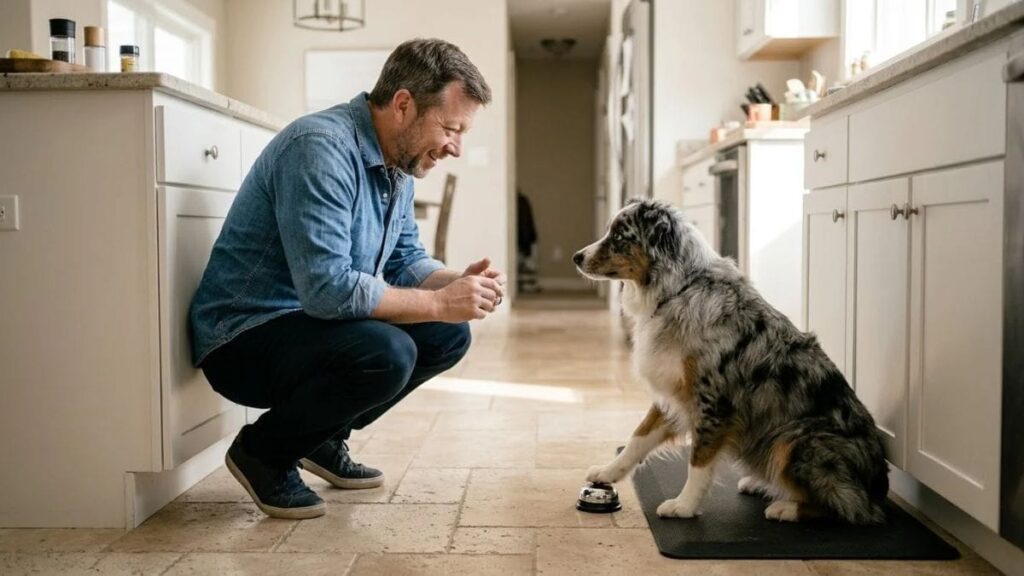
Before introducing new props, check that they are stable, safe and suitable for your dog’s size. Our dog supplies checklist can help you organise everyday training equipment.
FAQs
What is the difference between luring and free-shaping in dog training tricks?
Luring uses food or a toy to guide a dog’s movement towards a position or action. Free-shaping rewards small voluntary steps that gradually approach a goal, without physically guiding the dog with a lure. Luring can be useful for introducing simple movements, while free-shaping encourages the dog to explore and offer behaviours independently.
How can I teach my dog to respond to verbal cues instead of hand signals?
First, make sure your dog understands the behaviour itself. Introduce the verbal cue consistently before the familiar hand signal, then gradually reduce the gesture as your dog begins responding to the word. Practise in a quiet environment and reward correct responses. Some dogs may continue to benefit from both verbal and visual cues.
Is back-chaining better than forward chaining for complex dog tricks?
Not in every situation. Back-chaining starts with the final action and adds earlier steps, which can be useful when the final behaviour is clear and rewarding. Forward chaining teaches the sequence from its first step. Choose the method that makes the individual actions and transitions easiest for your dog to understand.
Can mixed-breed dogs earn AKC Trick Dog titles?
Yes. Eligible mixed-breed dogs can participate through the AKC Canine Partners programme, provided they meet the programme’s registration requirements. The AKC offers five Trick Dog titles, from Novice through Trick Dog Elite Performer. Check the current AKC Trick Dog programme requirements before applying.
How should I adapt trick training for puppies and senior dogs?
Choose activities that match the dog’s development, mobility and comfort. Puppies can start with gentle targeting and simple object interactions, while senior dogs may enjoy scent games, calm nose touches and cooperative-care behaviours. Avoid demanding movements if the dog is still growing, has mobility problems or shows discomfort. Ask your veterinarian for individual advice when health or physical limitations are involved.
Conclusion
Dog training tricks become more rewarding when you approach them as a gradual learning process rather than a race to master complicated routines. Luring, capturing, targeting and free-shaping each offer useful ways to teach new behaviours, while chaining and cue practice help connect those skills into more involved activities.
There is no single progression that suits every dog. Some enjoy learning prop-based routines, while others prefer simple targeting games and familiar movements. The important thing is to keep training positive, make each step understandable and respect your dog’s physical comfort.
Choose one behaviour your dog already understands and practise improving its response in a calm setting. When you are ready to explore individual activities, visit our fun dog training tricks guide for 15 step-by-step ideas.