Bringing a dog home comes with plenty of happy moments, but it also means learning how to communicate with a new companion. From teaching simple commands to establishing toilet routines, the early lessons you introduce can make everyday life safer and more enjoyable.
Mastering dog training basics is not about making a dog obey every instruction perfectly. It is about building trust, setting clear expectations and helping your dog understand which behaviours lead to positive outcomes. With patience, consistency and appropriate rewards, new owners can teach practical skills without relying on fear or punishment.
Every dog learns at a different pace. Puppies may need frequent repetition, while adult dogs can bring previous habits and experiences into a new home. Your approach should reflect your dog’s age, temperament, health and comfort level. Start with manageable exercises, celebrate small improvements and give your companion enough time to learn.
Key Takeaways
- Reward-based training helps dogs understand and repeat desirable behaviours.
- Short, consistent practice sessions are usually more useful than lengthy lessons.
- Start with essential cues such as sit, down, stay, come and leave it.
- Introduce crate training and toilet routines gradually.
- Positive early experiences help puppies become more comfortable with everyday situations.
1. Understand How Dogs Learn
Before teaching commands, it helps to understand what motivates your dog. Dogs learn through the consequences of their actions. When a behaviour leads to something enjoyable, such as a treat, playtime or praise, the dog is more likely to repeat it.
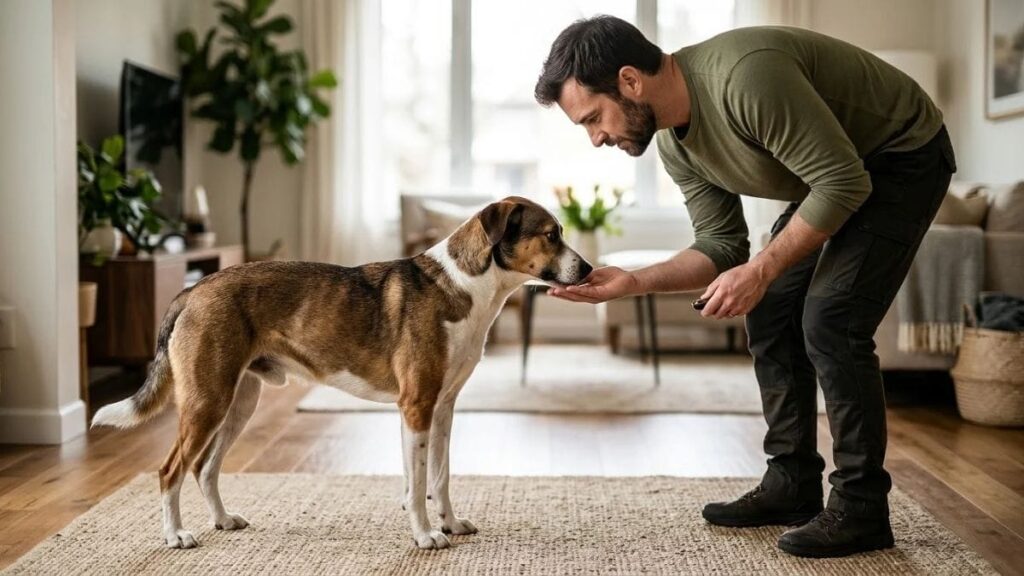
This is the foundation of positive reinforcement. For example, if your dog sits while you prepare its meal, reward the sit. If your puppy looks towards you during a walk, acknowledge that attention with praise or a small treat.
Choose Rewards Your Dog Actually Enjoys
Not every dog responds to the same reward. Some are highly motivated by food, while others prefer a favourite toy, a short game or enthusiastic praise.
Try different options and notice what holds your dog’s attention. Training treats should be small enough to avoid filling your dog up too quickly. If you use food rewards frequently, account for them within your dog’s daily food allowance.
Use a Marker to Make the Timing Clear
A marker is a short sound or word that identifies the exact moment your dog performs the behaviour you want. You can use a word such as “yes” or a clicker.
The sequence is simple:
- Wait for the behaviour you want to encourage.
- Say “yes” or click at the moment it happens.
- Immediately follow the marker with a suitable reward.
- Repeat so your dog begins to associate the marker with a reward.
Before using a marker to teach new skills, introduce the association in a quiet environment. Say “yes” and give your dog a small treat. Repeat several times until your dog starts anticipating the reward after hearing the marker.
The marker identifies the behaviour; the treat, toy or other reward follows it. This helps your dog understand which action earned the reward.
Reward-based training does not mean allowing unsafe or unwanted behaviour. Owners can establish boundaries by managing the environment, preventing access to dangerous objects and teaching alternative behaviours. The American Veterinary Society of Animal Behavior’s humane dog training position statement recommends reward-based methods for dog training and behaviour modification rather than techniques involving force, pain or intimidation.
Choose Rewards Your Dog Actually Enjoys
Not every dog responds to the same reward. Some are highly motivated by food, while others prefer a favourite toy, a short game or enthusiastic praise.
Try different options and notice what holds your dog’s attention. Training treats should be small enough to avoid filling your dog up too quickly. If you use food rewards frequently, account for them within your dog’s daily food allowance. Dogs following veterinary-prescribed diets or managing health conditions may need specific treats, so check with your veterinarian before introducing new foods.
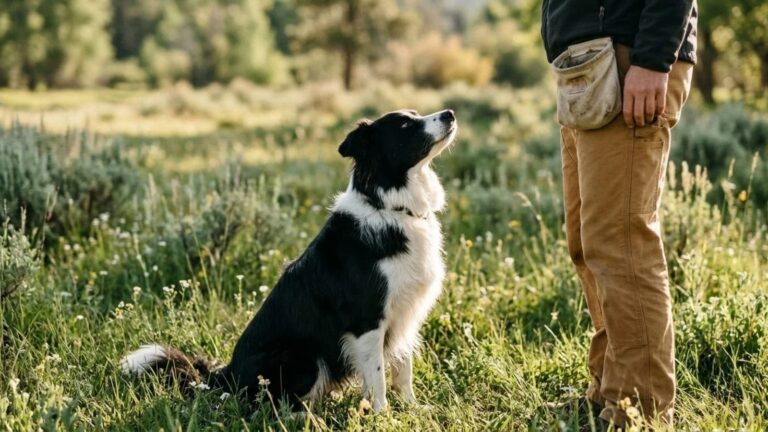
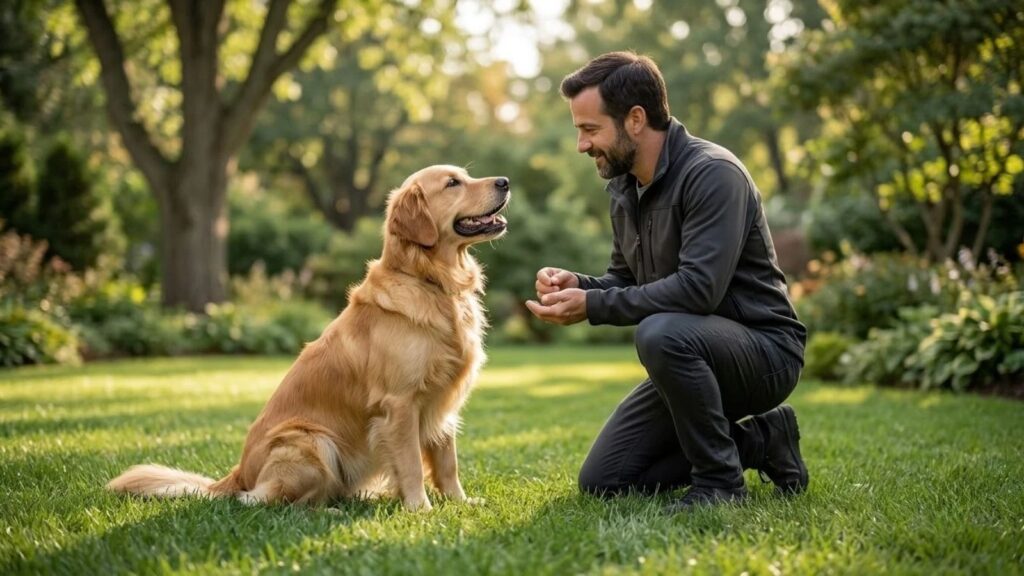
Image: Mastering dog training basics through reward-based training with a sitting dog.
2. Prepare Before Your First Training Session
A little preparation can make each lesson easier. Choose a quiet area where your dog can concentrate without too many distractions. Keep treats or toys nearby and decide which cue words everyone in the household will use.
For example, if one person says “down” to ask the dog to lie down while another uses it to mean get off the sofa, the dog may become confused. Agree on simple, consistent words for each behaviour.
Keep these points in mind:
- Choose a quiet location: Begin indoors or in a familiar area before practising around distractions.
- Use suitable rewards: Find out whether your dog responds best to food, toys, play or praise.
- Keep sessions brief: Several short lessons can be easier to manage than one long session.
- Use clear cues: Say the command once and give your dog time to respond.
- Finish positively: End with an easy exercise your dog already understands.
- Be patient: If your dog struggles, reduce the difficulty instead of repeating the command more loudly.
Get the Timing Right
When a dog is learning a new behaviour, reward each correct response. Mark the behaviour at the moment it happens, then deliver the reward promptly. This helps your dog connect the action with the positive outcome.
Once your dog understands a cue, you can gradually vary the type of reward. However, continue to reinforce good responses, especially when you introduce new distractions or practise in unfamiliar places.
The AVSAB humane dog training position statement explains why reward-based methods are recommended for teaching everyday skills and addressing behaviour concerns.
3. Teach Five Essential Dog Training Commands
Basic commands help owners communicate with their dogs in everyday situations. They can also support safer handling and better household routines.
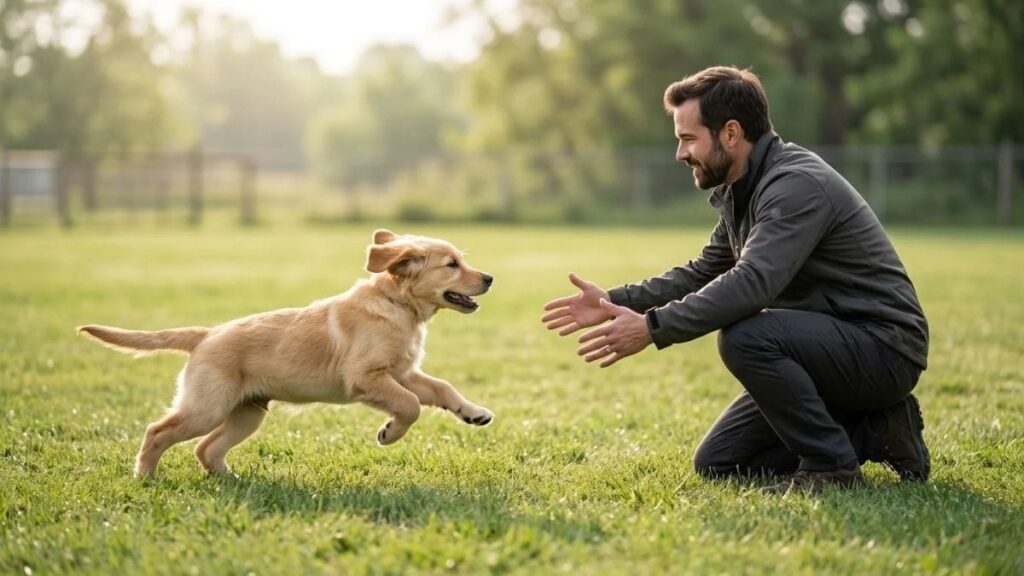
Begin in a quiet environment and teach one skill at a time. Do not expect your dog to perform reliably around unfamiliar people, other animals or exciting distractions until you have practised gradually.
Command 1: Sit
Sit is a useful starting point because it can encourage calm behaviour before meals, walks and greetings.
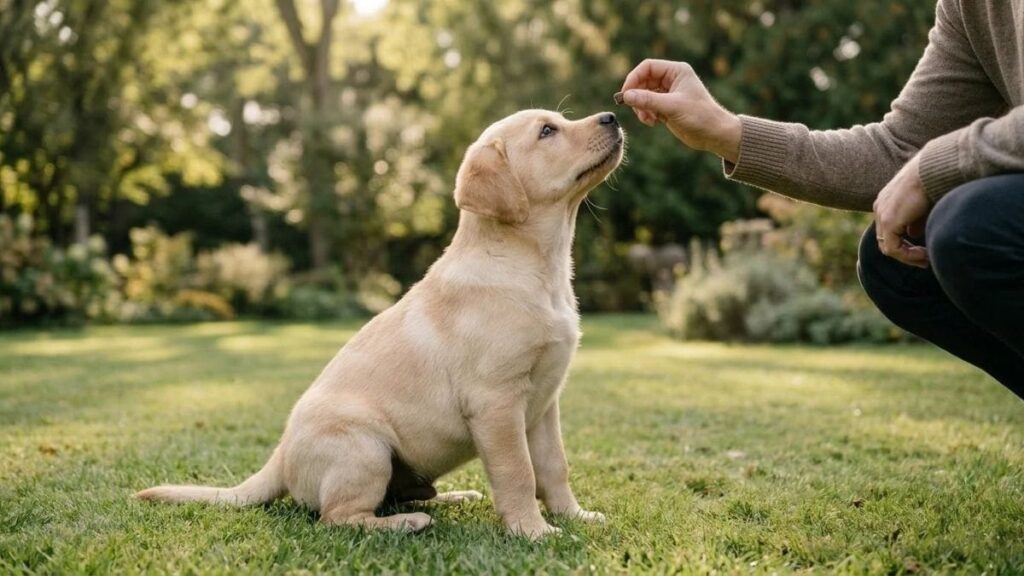
- Hold a small treat close to your dog’s nose.
- Slowly move the treat upwards and slightly backwards.
- Allow your dog to follow the treat naturally.
- When its hindquarters reach the floor, mark the behaviour with “yes” and give the reward.
- Once your dog begins to understand the movement, introduce the word “sit” just before the action.
Practise a few repetitions and then take a break. Never push your dog’s hindquarters down. If sitting appears uncomfortable, stop and consider whether a mobility or health problem needs attention.
Command 2: Down
The down command teaches your dog to settle into a lying position.
- Begin with your dog standing or sitting comfortably.
- Hold a treat near its nose.
- Slowly move the treat towards the floor.
- Mark and reward when your dog’s elbows reach the ground.
- Introduce the word “down” once the movement becomes familiar.
Some dogs need more time to feel comfortable lying down. Reward small steps towards the position rather than forcing your dog into it.
Command 3: Stay
Stay can help your dog remain in one place while you move a short distance away.
- Ask your dog to sit or lie down.
- Show an open palm and say “stay”.
- Wait for a brief moment.
- Return to your dog and reward it for remaining in position.
- Gradually increase the duration and distance.
Use a release word such as “free” to tell your dog when the exercise has ended. Increase duration, distance and distractions separately rather than making all three more difficult at once. If your dog gets up, calmly make the next attempt easier.
Command 4: Come
A reliable recall can be an important safety skill. Start indoors or in a securely enclosed area.
- Say your dog’s name followed by “come”.
- Use a cheerful voice and move a short distance away.
- Reward your dog generously when it reaches you.
- Repeat during short, enjoyable practice sessions.
- Gradually practise in new environments with suitable safety precautions.
Use a long training line in appropriate outdoor spaces while recall is still developing. Never test an unreliable recall near traffic, open gates or other hazards.
Make coming to you a positive experience. Avoid calling your dog to punish it, end every enjoyable activity or do something frightening.
Command 5: Leave It
Leave it teaches your dog to move away from something you do not want it to investigate.
- Place a treat inside your closed hand.
- Allow your dog to sniff without opening your hand.
- Wait for your dog to move its nose away or turn its attention elsewhere.
- Mark that moment with “yes”.
- Reward with a different treat from your other hand.
- Once your dog understands the exercise, introduce the words “leave it” before presenting the closed hand.
Practise with safe objects before increasing the difficulty. Keep medicines, chemicals, sharp objects and dangerous foods out of reach. A training cue is not a substitute for preventing access to hazards. If your dog has already swallowed something potentially harmful, contact a veterinarian promptly rather than relying on a training command.
4. Introduce Crate Training Gradually
A crate can provide a quiet resting space and help with safe management at home or during travel. However, it should never be used as punishment or as a substitute for exercise, attention and appropriate toilet breaks.
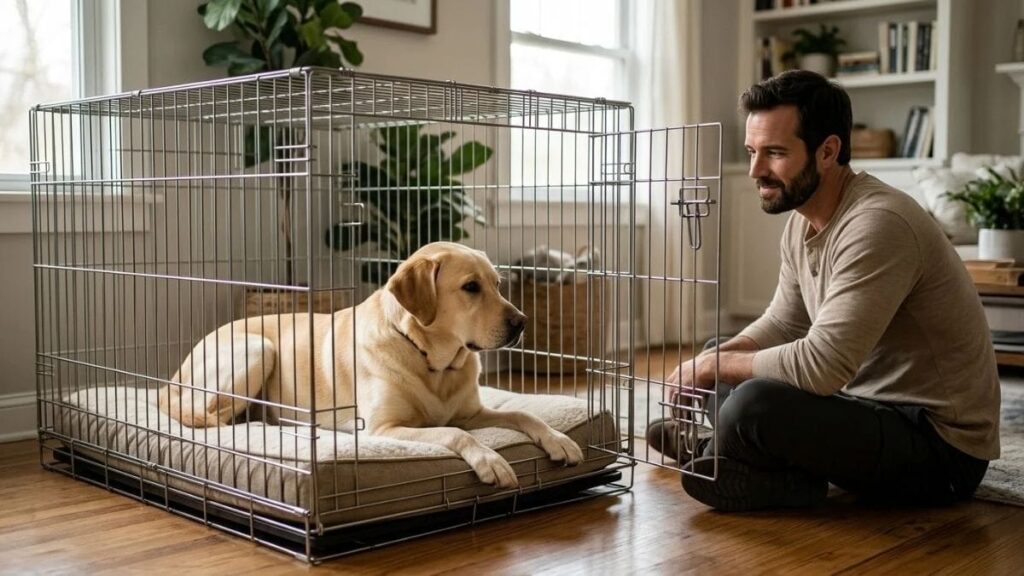
Choose a crate that allows your dog to stand, turn around and lie down comfortably. Begin with the door open. Place a few treats or your dog’s meal near the entrance and let it investigate voluntarily.
Once your dog is comfortable entering, reward it for spending a little time inside. Gradually practise closing the door for a few seconds while staying nearby. Open it again while your dog is still comfortable. Increase the duration slowly as your dog becomes more relaxed.
A few helpful crate-training practices include:
- Make the crate comfortable with suitable bedding that is safe for your dog.
- Allow your dog to explore it at its own pace.
- Offer meals or rewards inside if your dog is comfortable.
- Avoid forcing your dog through the entrance.
- Provide appropriate toilet opportunities before longer rest periods.
- Never leave a dog confined longer than it can comfortably manage.
- Give your dog regular opportunities for exercise, interaction and rest outside the crate.
What If Your Dog Whines in the Crate?
Whining can have different causes. A young puppy may need a toilet break, while another dog may be uncomfortable, frightened, bored or struggling with confinement.
Check whether your dog needs to toilet or whether something in the environment is causing discomfort. If your dog shows signs of panic, repeatedly tries to escape or becomes increasingly distressed, stop increasing the confinement time and reassess the approach. Do not leave a distressed dog confined in the hope that it will simply get used to the crate.
Some dogs need a different management plan, particularly when separation-related distress is involved. Ask your veterinarian or a qualified behaviour professional for help if the problem continues.
The American Kennel Club’s step-by-step crate training guide provides further advice on gradual introduction and responding to problems during crate training.
Image: Relaxed dog resting inside an open crate.
5. Establish a Consistent Potty Training Routine
Toilet training takes patience, supervision and regular opportunities to go outside. Puppies have developing bladder control, so they generally need more frequent breaks than adult dogs. Very young puppies may need opportunities as often as every 30 to 60 minutes while awake, although individual needs vary.
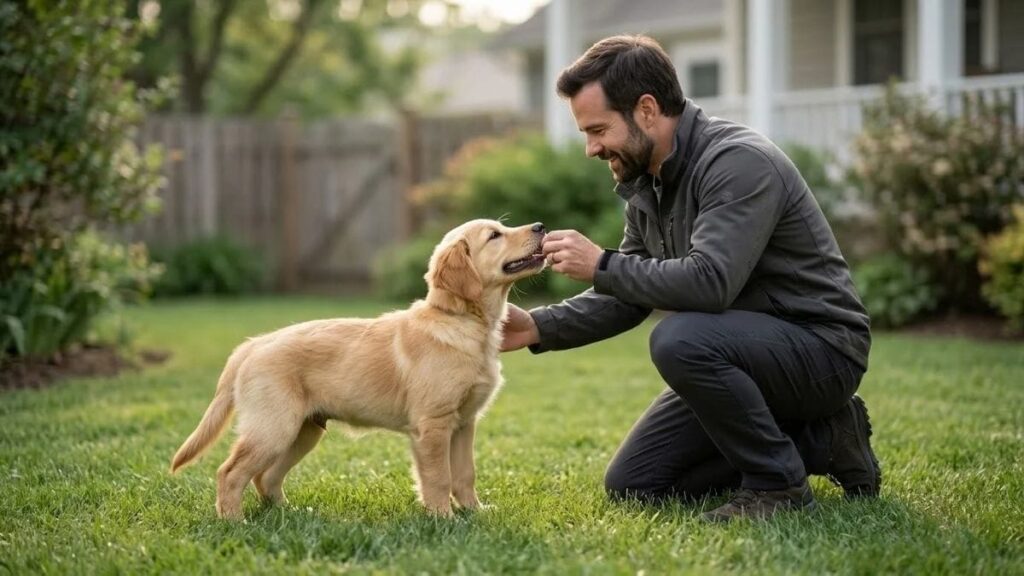
Take your puppy outside after waking, eating, drinking and playing. Also provide regular opportunities throughout the day and overnight when necessary. Adjust the schedule according to your puppy’s age, routine, behaviour and ability to stay comfortable between breaks.
Steps for Successful Potty Training
Choose a regular toilet area. If practical, take your puppy to the same outdoor spot each time. Familiar surroundings can help establish a routine.
Watch for signs. Sniffing, circling, suddenly leaving a play area or moving towards the door may indicate that your puppy needs to go.
Reward immediately. When your puppy toilets in the correct place, offer praise or a small treat straight away. Use a marker word if you have introduced one.
Supervise indoors. Keep your puppy within sight when possible. Use suitable barriers or a safe play area when you cannot supervise closely.
Clean accidents properly. Use an appropriate enzymatic cleaner to remove odours that may encourage repeat accidents.
Avoid Punishment for Accidents
Accidents are a normal part of learning. Shouting, frightening your puppy or rubbing its nose in the mess will not teach the correct toilet location.
If you catch your puppy starting to go indoors, calmly interrupt if appropriate and take it outside. Reward it if it finishes in the right place. If you find an accident after it has happened, clean it up without punishment. Your puppy will not understand a delayed reprimand.
If a previously reliable dog suddenly begins having accidents, arrange a veterinary check. Urinary, digestive and other health problems can affect toilet habits. The American Humane Society’s housetraining guide offers further advice on supervision, regular toilet opportunities and positive reinforcement.
Image: Owner rewarding a puppy after outdoor potty training.
6. Socialize Your Puppy Through Positive Experiences
Socialization helps puppies become more comfortable with the people, animals, sounds, places and everyday situations they may encounter throughout life.
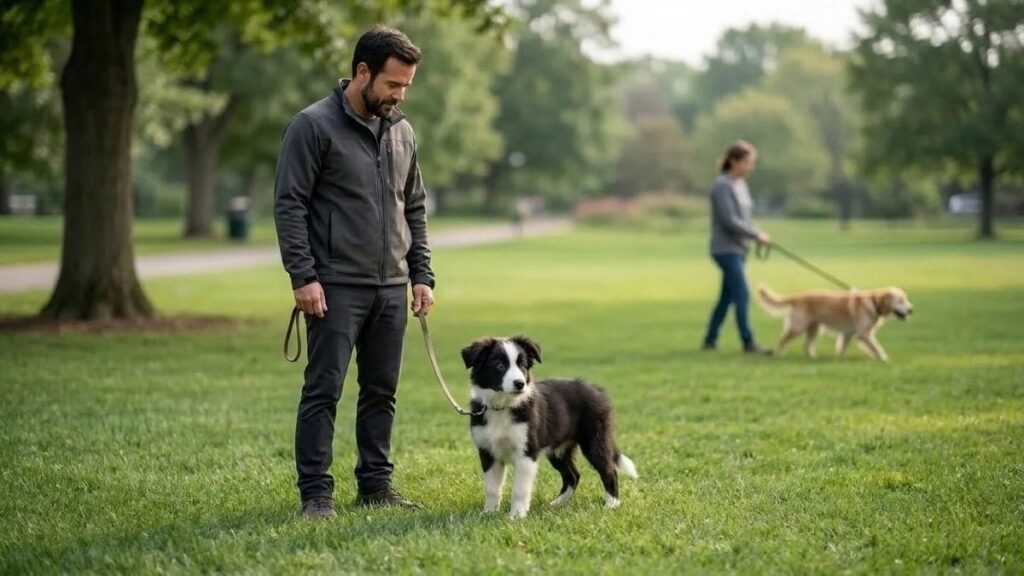
The first three months are an especially important period for positive early experiences. Introduce new situations gradually and allow your puppy to observe from a comfortable distance. The goal is to build confidence, not to expose the puppy to as many things as possible regardless of how it feels.
Useful early experiences may include:
- Meeting calm, friendly people.
- Hearing ordinary household sounds.
- Walking on different safe surfaces.
- Seeing bicycles, cars and people using mobility aids.
- Experiencing gentle handling.
- Observing other dogs from a safe distance.
- Becoming familiar with suitable travel routines.
The goal is not to make your puppy meet everyone or approach every unfamiliar dog. It is to help the puppy feel safe and comfortable while discovering the world.
Keep New Experiences Safe
Watch your puppy’s body language. If it moves away, hides, freezes or appears frightened, give it more space. Do not force it to approach a person, animal or object. Let your puppy observe at a distance where it can remain relaxed, and reward calm curiosity.
Puppies also need protection from infectious diseases. Socialization should not automatically be postponed until every vaccination is complete, but exposure must be planned carefully. Ask your veterinarian which puppy classes, outdoor environments and dog contacts are appropriate for your puppy’s age, vaccination status and local disease risks.
The AVSAB Puppy Socialization Position Statement explains why safe, positive experiences during early puppyhood are important. It also discusses puppy classes and vaccination precautions.
Socialization continues after puppyhood. Adult dogs can also become more comfortable with new experiences, although the process may need to be slower and tailored to their previous experiences.
Image: Puppy calmly exploring a new environment beside its owner.
7. Avoid Common Dog Training Mistakes
Even experienced owners can make training harder by expecting too much too quickly. Recognising common mistakes can help you adjust your approach.
Repeating Commands Too Often
Repeating “sit” several times may teach your dog that it does not need to respond to the first cue. Say the command once and give your dog a moment to respond. If it struggles, simplify the exercise or make the reward more appealing.
Making Sessions Too Long
Dogs can become distracted or frustrated during lengthy practice. Short, focused sessions are often easier to manage, especially for young puppies. Finish before your dog becomes tired or loses interest.
Changing Household Rules
If one person encourages jumping while another discourages it, your dog receives mixed information. Agree on household rules and use consistent cues. Make sure everyone understands which behaviours should be rewarded.
Rewarding Too Late
A delayed marker or reward may reinforce the wrong behaviour. Use a marker word or clicker to identify the correct action and follow it promptly with a reward.
Adding Distractions Too Quickly
A dog that responds indoors may struggle in a busy park. Practise in increasingly challenging environments rather than expecting the same performance everywhere immediately.
Using Fear or Physical Punishment
Punishment can create fear, damage trust and make some behaviour problems worse. Focus on teaching an appropriate alternative and managing situations where unwanted behaviour is likely to occur. AVSAB recommends reward-based methods rather than aversive techniques for dog training and behaviour modification.
If your dog repeatedly struggles, consider whether the cue is clear, the reward is valuable and the environment is too difficult. A dog that does not respond is not necessarily stubborn. It may be confused, distracted, uncomfortable or worried.
8. Understand When Professional Help Is Needed
Basic training can address many everyday skills, but some behaviour problems require more than a beginner’s approach.
Consider professional support if your dog shows:
- Persistent fear around people, animals or unfamiliar situations.
- Growling, snapping or biting.
- Severe distress when left alone.
- Repeated destructive behaviour associated with distress.
- Sudden changes in temperament or behaviour.
- Difficulty coping with ordinary household routines.
Start with your veterinarian, especially if the behaviour is new or accompanied by signs of pain or illness. A medical issue may be contributing to what appears to be a training problem.
When choosing a trainer, ask about their methods, experience and approach to difficult situations. Ask what they do when a dog is frightened, refuses a cue or displays aggression. Look for someone who explains their techniques clearly, uses reward-based methods and respects the dog’s comfort.
Avoid trainers who rely on intimidation, physical corrections, pain-based equipment or promises of instant results. A responsible professional should be willing to explain the training plan, discuss realistic progress and recommend veterinary or specialist support when a problem goes beyond basic obedience.
For serious fear, aggression or bite risk, prioritise safety and seek veterinary guidance. Do not punish growling. It is a warning signal that the dog is uncomfortable, and suppressing that signal does not resolve the underlying problem.
9. Make Training Part of Everyday Life
Training does not have to happen only during planned sessions. Everyday routines offer opportunities to reinforce useful behaviours.
Ask your dog to sit before putting down its food bowl. Reward calm behaviour when visitors arrive. Practise recall during a safe game in an enclosed space. Encourage your dog to settle on a comfortable bed while you prepare a meal.
As your dog becomes more confident, practise familiar skills in different rooms and suitable outdoor environments. Continue rewarding good choices, even after your dog has learned the basic command. Skills can become less reliable when the surroundings change, so occasional practice helps maintain them.
For more help with everyday routines, read our complete dog care guide. If you are preparing for a new arrival, our dog supplies checklist can help you organise essential items before bringing your dog home.
FAQs
How long does it take to train a dog?
There is no fixed timeline. A dog may learn a simple cue in a few sessions but need much longer to respond reliably around distractions. Age, experience, health, motivation and practice all affect progress. Focus on steady improvement rather than a deadline.
What is the first thing I should teach a new dog?
Start by building a positive relationship and a predictable routine. Teach the dog’s name, reward attention and introduce a simple cue such as sit. Toilet habits, safe handling and recall are also useful early priorities.
Can older dogs learn new commands?
Yes. Adult and senior dogs can learn new behaviours. Keep sessions appropriate for their mobility, health and attention span. If a dog suddenly struggles with a behaviour it previously knew, ask a veterinarian whether pain or another health issue could be involved.
Should I use treats every time my dog follows a cue?
Use frequent rewards while a behaviour is new. Once your dog understands it, you can vary the type and frequency of rewards while continuing to reinforce good responses. Food is not the only option; toys, play and praise may also be rewarding.
What if my dog ignores me during training?
Make the exercise easier. Reduce distractions, use a reward your dog values and check that your cue is clear. If your dog seems frightened, uncomfortable or unusually unresponsive, stop and investigate the cause rather than repeating the command.
Conclusion
Mastering dog training basics starts with understanding how dogs learn and creating a positive, consistent environment. Teach essential commands gradually, reward desirable behaviour and establish predictable routines for crate use, toilet training and socialization. Do not expect immediate perfection. Your dog needs time to understand new cues and practise them in different situations.
The most effective training approach protects your dog’s wellbeing while helping it become a confident member of your household. Be patient, recognise small improvements and seek professional guidance when behaviour concerns go beyond everyday training. With clear communication and consistent practice, you can build skills that support a safer and more rewarding life together.