Farm dog breeds do more than share a home with their owners. Some move cattle and sheep across a pasture, while others stay with a flock and help protect it from predators. A few are versatile working dogs, and others are better suited to life as a farm companion.
Choosing the right dog takes more than looking at breed size or appearance. You need to consider the work involved, the animals on your property, available space, fencing, exercise, grooming and the time you can give a dog every day.
This guide explores 14 farm dog breeds, what each breed was developed to do and the responsibilities that come with owning one. It also explains why a herding dog and a livestock guardian are not interchangeable. Individual dogs vary, and a breed’s reputation cannot guarantee that a particular dog will suit your operation.
Key Takeaways
- Herding dogs gather and move livestock, usually in response to human direction. They need regular physical activity and mental work.
- Livestock guardian dogs live with the flock and protect it through independent behaviour. They need suitable livestock bonding, management and secure boundaries.
- Breed is only one part of the decision. The individual dog’s temperament, background and suitability for your farm matter too.
- Some guardian breeds are independent, territorial or prone to roaming. Fencing and responsible handling are important considerations.
- Health screening, grooming, feeding and veterinary care should be part of your farm-dog budget before you bring a dog home.
Herders and Guardians: Two Different Jobs
Herding dogs and livestock guardian dogs have different responsibilities. Understanding that distinction is the first step towards choosing suitable farm dog breeds.
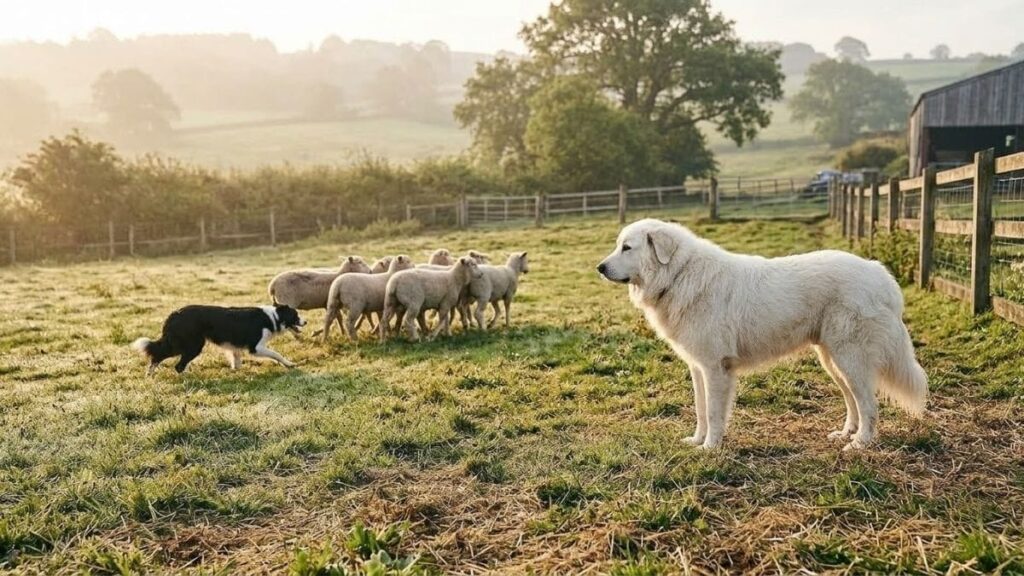
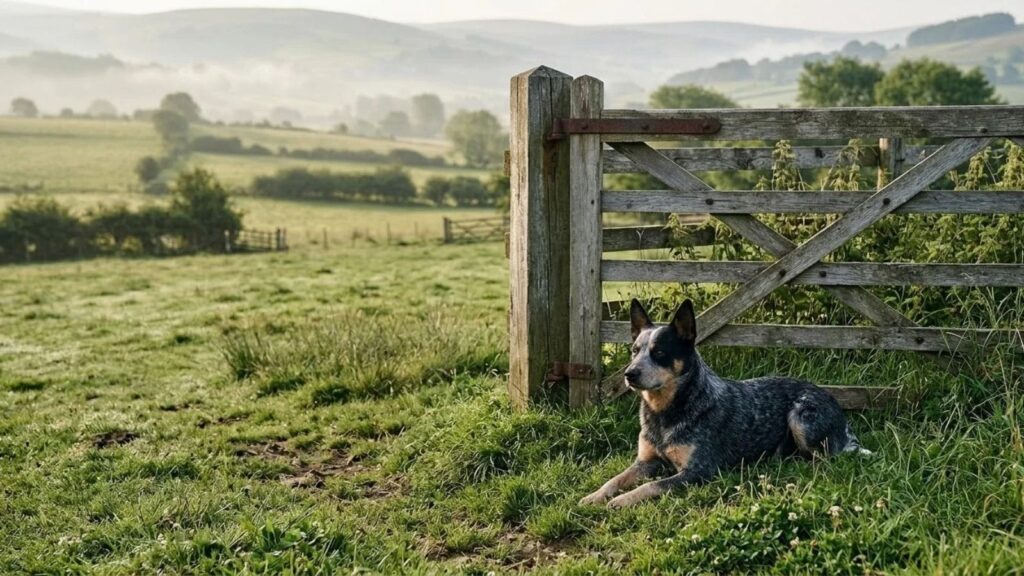
A herding dog gathers, moves and directs livestock. It may work close to a farmer, respond to commands and use controlled movement to guide animals towards a gate, pen or pasture. Border Collies and Australian Cattle Dogs are familiar examples.
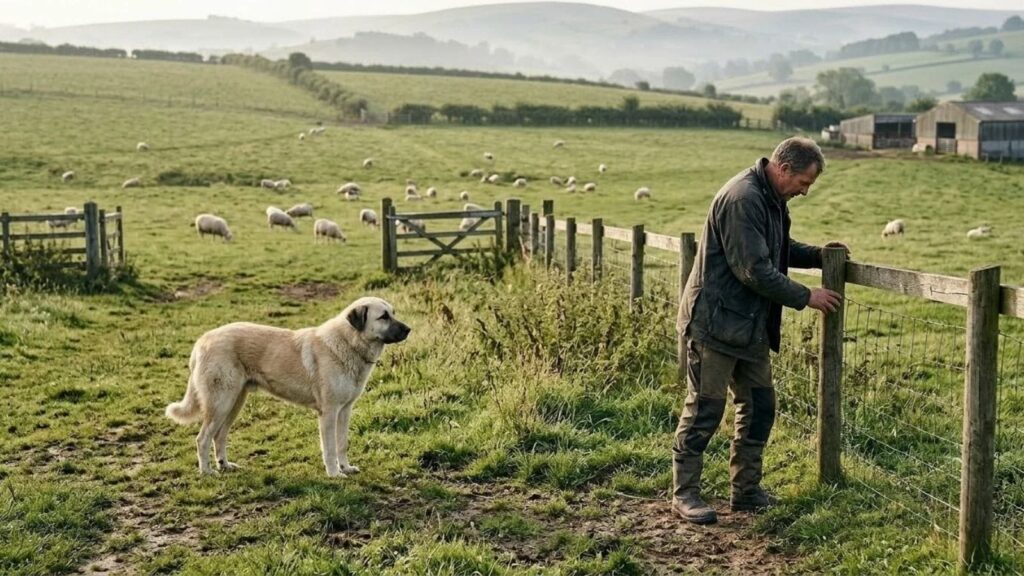
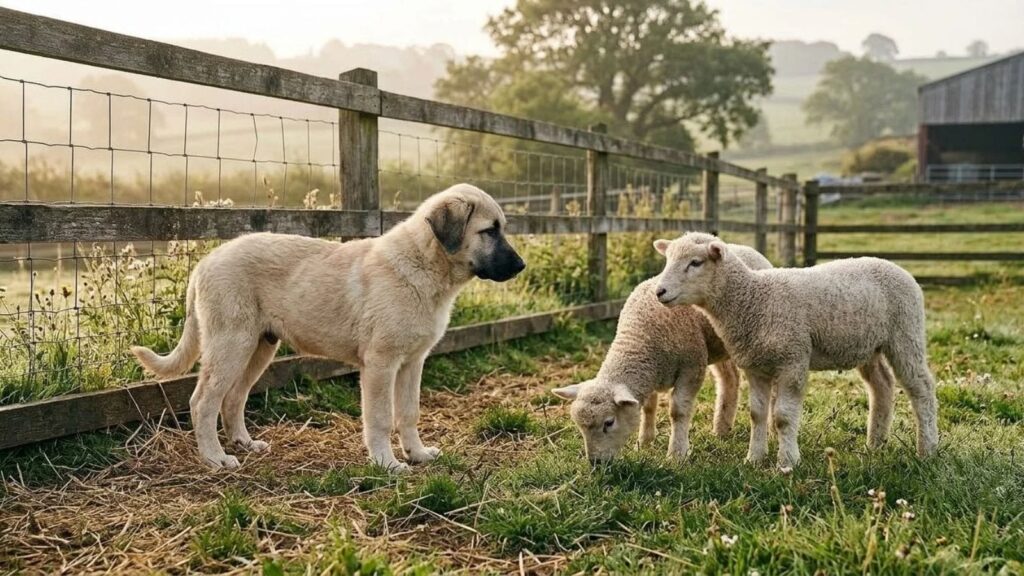
A livestock guardian dog has a different role. It lives among the animals it protects and uses its presence, alertness and protective instincts to discourage predators. Great Pyrenees and Anatolian Shepherds are examples of breeds commonly used for this work.
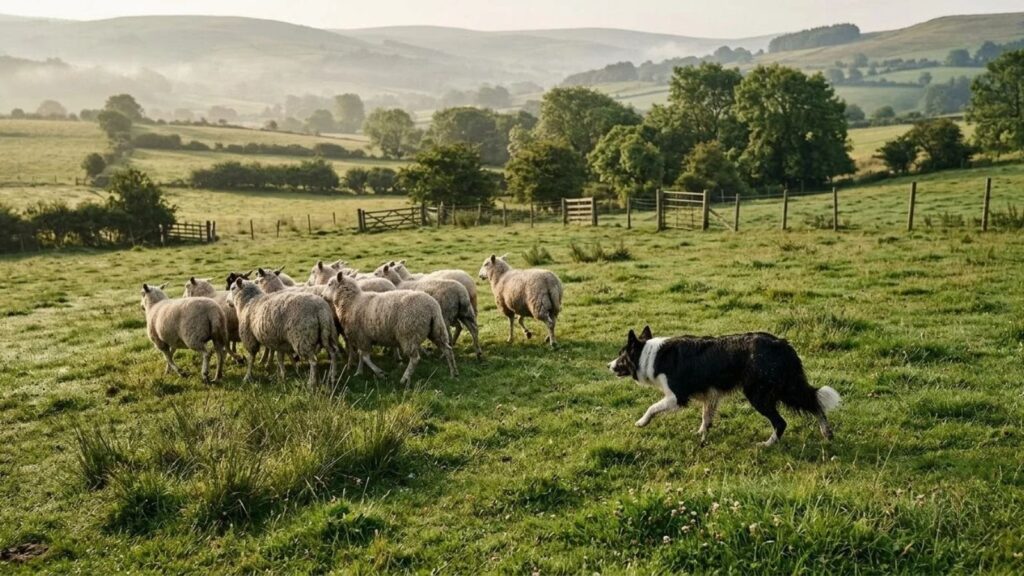
These jobs are not interchangeable. A livestock guardian is not automatically suited to driving sheep through a gate, and a herding dog should not be expected to provide the same independent protection as a dog bred to guard a flock.
Some farm dogs have other working backgrounds. The Belgian Malinois, for example, has herding origins but is also widely associated with demanding working roles. The Bernese Mountain Dog is better considered a farm companion than a livestock herder or guardian.
The profiles below are grouped by their main role. Size and lifespan figures are typical ranges reported by the linked breed profiles, not promises about an individual dog’s adult size or longevity.
The 14 Farm Dog Breeds
Herding Breeds
These breeds were developed to help people manage livestock. Their working instincts can be useful on a farm, but they also need appropriate outlets for their energy and intelligence.
1. Border Collie
The Border Collie is known for its intelligence, responsiveness and ability to move livestock with controlled movements. It is often considered a strong choice for farms where sheep or other animals need regular herding.
PetMD’s Border Collie breed profile gives a typical weight range of 30 to 55 pounds and a lifespan of 12 to 15 years. It describes a dog that may need one to two hours or more of daily activity. The VCA Border Collie breed guide reports similar size and lifespan ranges.
This breed needs more than a short walk. Without enough activity and mental stimulation, a Border Collie may become restless, bark excessively or try to herd children and other pets. Its coat generally needs brushing several times a week, with heavier seasonal shedding.
Health concerns reported in the breed profiles include hip dysplasia, epilepsy, Collie eye anomaly and the MDR1 drug-sensitivity gene. Discuss appropriate screening and medication considerations with a veterinarian.
Farm fit: A highly capable herding dog for an active operation where it can work regularly and receive consistent attention.
2. Australian Cattle Dog
The Australian Cattle Dog was developed to help move cattle across challenging terrain. It is compact, muscular and persistent, with a working style that can include nipping at the heels of livestock.
PetMD’s Australian Cattle Dog profile lists a typical weight of 35 to 50 pounds and recommends substantial daily activity. The VCA Australian Cattle Dog guide gives a lifespan range of 12 to 16 years.
This breed is energetic and can be reserved around unfamiliar people. Its intelligence and determination make it a useful worker, but they can also make it challenging for an inexperienced owner. Regular exercise, training and purposeful activity are important.
The coat is relatively easy to maintain, although shedding can increase seasonally. Health concerns listed by the breed sources include deafness, hip dysplasia and progressive retinal atrophy. The VCA profile also mentions primary lens luxation.
Farm fit: A tough, energetic cattle worker for owners who can provide structure, daily activity and experienced handling.
3. Australian Shepherd
The Australian Shepherd is an energetic herding breed known for its intelligence, agility and close working relationship with people. It can help manage livestock while also adapting to other demanding activities.
PetMD’s Australian Shepherd breed profile lists a typical weight of 40 to 65 pounds and a lifespan of 12 to 15 years. The VCA Australian Shepherd guide gives a similar size range.
An Australian Shepherd needs regular physical and mental activity. Its herding instinct may be directed towards children or smaller animals, so supervision and training matter. Secure boundaries are also important because some individuals may try to escape when bored or under-stimulated.
Weekly brushing helps manage the coat, with heavier shedding commonly occurring during seasonal changes. Reported health concerns include hip and elbow dysplasia, eye conditions, epilepsy and MDR1 drug sensitivity. Merle-associated hearing or vision problems may also be relevant, depending on the dog’s genetics.
Farm fit: A versatile herding dog for an active farm where it can work, train and stay involved with its owner.
4. Old English Sheepdog
The Old English Sheepdog is a large, sturdy breed historically associated with droving and farm work. Its shaggy coat gives it a distinctive appearance, but that coat also creates a significant grooming commitment.
PetMD’s Old English Sheepdog profile lists a typical weight range of 60 to 100 pounds and a lifespan of 10 to 12 years. The VCA Old English Sheepdog breed guide lists a weight range of 60 to 80 pounds.
Although the breed can be affectionate and adaptable, it needs regular companionship and should not be left alone for long periods. Its thick coat requires frequent brushing and combing to prevent tangles and matting. Owners should also take care during hot weather.
Reported health concerns include hip dysplasia, eye disease, thyroid conditions, deafness and MDR1 drug sensitivity.
Farm fit: A substantial farm dog with a traditional working background, best for owners prepared to manage its coat and provide regular company.
5. Pembroke Welsh Corgi
The Pembroke Welsh Corgi may be small, but it was developed to work with cattle. Its low-set body and quick movements help it avoid the kicks of larger animals while moving them through a herd.
PetMD’s Pembroke Welsh Corgi profile lists a typical weight of around 30 pounds and a lifespan of 12 to 13 years. The VCA Pembroke Welsh Corgi guide gives a weight range of 25 to 27 pounds and a lifespan of 11 to 13 years.
Corgis are alert, active and often vocal. Their herding instincts may lead them to nip at heels, including those of children, so training and supervision are important. They can adapt to different home sizes, but still need regular exercise and mental activity.
The double coat sheds heavily, and brushing helps manage loose hair. Weight control is also important because excess weight can put additional strain on the dog’s body.
Health concerns listed in the breed profiles include hip and elbow dysplasia, cataracts, degenerative myelopathy and obesity.
Farm fit: A small but determined cattle herder for owners who want a compact working dog and can manage its activity, barking and weight.
6. Shetland Sheepdog
The Shetland Sheepdog, often called the Sheltie, is a small herding breed developed to work with livestock. It is known for being responsive, intelligent and attentive to its surroundings.
PetMD’s Shetland Sheepdog profile lists a typical weight range of 15 to 25 pounds and a lifespan of 12 to 14 years. The VCA Shetland Sheepdog breed guide describes the breed as highly trainable.
Shelties often bark to alert their owners or respond to activity around them. Some may also try to herd children or other animals. Their small size does not remove the need for regular exercise and purposeful activity.
The long double coat needs frequent brushing, particularly during heavier shedding periods. Health concerns reported in the breed profile include hip dysplasia, Collie eye anomaly, thyroid disease and epilepsy.
Farm fit: A quick, trainable small herder for a farm where barking is manageable and the dog has regular work or activity.
7. Catahoula Leopard Dog
The Catahoula Leopard Dog is a strong, athletic breed associated with herding and hunting. It is known for its striking coat patterns, independent nature and need for substantial activity.
PetMD’s Catahoula Leopard Dog profile lists a typical weight range of 50 to 95 pounds and a lifespan of 10 to 14 years. It describes the breed as independent and potentially challenging to train. Hill’s Catahoula breed information also describes its herding and hunting background and high exercise needs.
A Catahoula needs room to move and consistent training. It may be vocal, strong-willed and wary of unfamiliar people. A securely fenced area is important, and owners should not assume that ordinary leash walks will meet its activity needs.
Both breed sources identify deafness as a concern. The Hill’s profile also discusses vision problems associated with merle colouring and joint conditions.
Farm fit: A powerful, independent working dog for experienced owners with space, secure fencing and a clear plan for daily activity.
Livestock Guardian Breeds
Livestock guardian dogs have a different working style from herding breeds. They are expected to remain with the animals they protect and respond to potential threats independently.
8. Great Pyrenees
The Great Pyrenees is a large livestock guardian breed developed to protect flocks. Its calm appearance can be misleading: it is independent, alert and capable of making decisions without waiting for constant direction.
PetMD’s Great Pyrenees breed profile lists females at around 85 pounds and males often above 100 pounds, with a lifespan of 10 to 12 years. The VCA Great Pyrenees guide gives a typical weight range of 85 to 120 pounds.
The breed may bark to alert its owners and can roam if its boundaries are not secure. Early socialisation and responsible management are important. Its thick coat needs regular brushing, especially during seasonal shedding.
Reported health concerns include hip and elbow dysplasia, eye conditions and bloat. The VCA profile also lists von Willebrand’s disease.
Farm fit: A traditional flock guardian for farms that can provide secure boundaries, suitable livestock management and room for an independent dog.
9. Anatolian Shepherd
The Anatolian Shepherd is a large, powerful livestock guardian developed to protect animals over wide areas. It is naturally alert and can be reserved around unfamiliar people.
PetMD’s Anatolian Shepherd profile lists males at 110 to 150 pounds and females at 80 to 120 pounds. The VCA Anatolian Shepherd guide gives a typical weight range of 80 to 150 pounds and a lifespan of 10 to 15 years.
This breed is independent and may make its own decisions when it senses a threat. It is generally better suited to experienced owners who understand guardian-dog behaviour. Fencing deserves particular attention because a large, determined dog may challenge a boundary if it feels the need to investigate a perceived threat.
Its coat sheds moderately, with heavier seasonal shedding. Reported health concerns include hip dysplasia, entropion, anaesthesia sensitivity and bloat.
Farm fit: A serious livestock guardian for experienced owners who can manage its size, independence, socialisation and secure boundaries.
10. Maremma Sheepdog
The Maremma Sheepdog is a livestock guardian associated with protecting sheep and other farm animals. It is generally described as independent and reserved around unfamiliar people.
The available Hill’s Maremma Sheepdog breed information lists a typical weight range of 30 to 45 kilograms. This is the only breed-specific page used for this profile, so its details should be treated as a starting point rather than a complete veterinary evidence review.
The breed has a thick double coat and may bark to alert its owners to activity around the flock. Secure fencing and suitable space are important. Regular exercise and coat care should be part of the owner’s routine.
The linked profile lists hip dysplasia, eyelid problems and possible sensitivity to anaesthesia and certain tick and flea products. Discuss any medication or parasite-control concerns with a veterinarian rather than changing treatment based on a breed profile.
Farm fit: A livestock guardian worth considering for a farm-based role, provided the owner can verify the dog’s background and arrange suitable management.
11. Komondor
The Komondor is a large Hungarian livestock guardian recognised for its distinctive corded coat. It was developed to protect livestock and is known for its independent, protective nature.
PetMD’s Komondor breed profile lists females above 80 pounds, males above 100 pounds and a lifespan of 10 to 12 years. The VCA Komondor guide gives a typical weight range of 80 to 125 pounds.
The coat is one of the breed’s biggest responsibilities. Its cords need careful maintenance to prevent dirt and moisture from becoming trapped. Bathing and drying can take considerable time, so owners should understand the grooming commitment before choosing this breed.
The Komondor can be territorial and is not generally an easy choice for a first-time dog owner. Reported health concerns include hip dysplasia, entropion and ear infections. The VCA profile also lists bloat.
Farm fit: A dedicated guardian for experienced owners who have the time and knowledge to manage its temperament and demanding coat.
12. Kuvasz
The Kuvasz is a large Hungarian breed historically used to guard livestock and property. It is loyal to its family but can be independent and wary of unfamiliar people or animals.
PetMD’s Kuvasz breed profile lists a typical weight range of 70 to 115 pounds and a lifespan of 10 to 12 years. It also describes high exercise needs and a strong desire for purposeful activity. The VCA Kuvasz guide gives a lifespan range of 9 to 15 years.
The breed needs consistent, thoughtful handling. Harsh training methods can damage the relationship between dog and owner. It may also roam if boundaries are not secure.
Its coat needs brushing several times a week, with noticeable shedding. Health concerns listed in the breed profile include bloat, hip dysplasia and thyroid disease.
Farm fit: A loyal guardian for an experienced owner who can provide structure, activity, socialisation and secure fencing.
Specialist Working Dog and Farm Companion
Not every dog that can live or work around a farm belongs in the herding or livestock guardian groups. These two breeds illustrate why the intended role matters.
13. Belgian Malinois
The Belgian Malinois is an athletic, highly driven working breed with a history that includes herding. It is now also widely associated with demanding roles such as detection, search and rescue and police work.
PetMD’s Belgian Malinois breed profile lists a typical weight range of 40 to 80 pounds and a lifespan of 10 to 14 years. It emphasises that ordinary daily walks are not enough for many individuals.
A Malinois needs structured exercise, training and purposeful mental work. Its high prey drive and intensity can make it difficult to manage around livestock, vehicles and other animals without suitable experience and supervision. It should not be selected simply because it is energetic or looks like a capable farm dog.
The available breed profile lists hip dysplasia, cataracts and progressive retinal atrophy among health concerns. The linked PetMD page was the only breed-specific source used for this profile.
Farm fit: A specialist working dog for an experienced handler with a clear training plan, not a default choice for livestock guarding or casual farm companionship.
14. Bernese Mountain Dog
The Bernese Mountain Dog is a large, affectionate breed with a history of farm work in Switzerland. Today, it is often valued as a family and farm companion rather than a specialist herding or livestock guardian dog.
PetMD’s Bernese Mountain Dog profile lists a typical weight range of 70 to 115 pounds and a lifespan of 7 to 10 years. The VCA Bernese Mountain Dog guide gives a lifespan range of 6 to 9 years.
The breed is generally described as patient and trainable, but its thick coat sheds heavily. It also needs protection from excessive heat and should have access to a comfortable, cool indoor space in hot weather. Many Bernese Mountain Dogs enjoy human company and may struggle when left alone for long periods.
Reported health concerns include bloat, hip and elbow dysplasia and histiocytic sarcoma.
Farm fit: A gentle, substantial companion for a farm household, but not a substitute for a dog bred and trained to herd or guard livestock.
Herder or Guardian? A Quick Comparison
The table below summarises the main roles discussed in these profiles. It is a starting point for choosing a dog, not a guarantee of an individual animal’s behaviour.
| Main role | Breeds in this guide | What the role requires |
|---|---|---|
| Herding | Border Collie, Australian Cattle Dog, Australian Shepherd, Old English Sheepdog, Pembroke Welsh Corgi, Shetland Sheepdog, Catahoula Leopard Dog | Direction, activity, training and regular work with livestock |
| Livestock guarding | Great Pyrenees, Anatolian Shepherd, Maremma Sheepdog, Komondor, Kuvasz | Livestock bonding, independent behaviour, secure boundaries and responsible management |
| Specialist working | Belgian Malinois | Experienced handling, structured training and a clearly defined job |
| Farm companion | Bernese Mountain Dog | Companionship, grooming, heat management and suitable exercise |
How to Choose Among Farm Dog Breeds
Start with the job your farm actually needs the dog to do. A herder and a livestock guardian have different instincts, training requirements and daily routines. Choosing the wrong type can create more work rather than solving a problem.
The SDSU Extension guide to livestock guardian dogs recommends considering breeder reputation and finding a dog raised in a way that suits the producer’s operation. It also explains that guardian-dog behaviour varies between individuals and that research comparing breed characteristics is limited.
Before choosing a puppy or adult dog, consider these questions:
- What work needs to be done? Decide whether you need a dog to move livestock, protect a flock or simply live safely around the farm.
- How much space and fencing are available? Some large guardian breeds may roam or challenge inadequate boundaries.
- Can you meet its daily needs? Exercise, training, grooming, feeding and veterinary care all require time and money.
- What is the dog’s background? Ask the breeder or rescue organisation about temperament, previous work, socialisation and health history.
- Does the individual dog suit your livestock and household? Consider its behaviour around animals, visitors, children and other dogs.
For livestock guardian dogs, early and appropriate bonding with the animals they will protect is especially important. The SDSU Extension guidance on guardian-dog protection discusses beginning this process when puppies are young, including the 8-to-20-week period. It also stresses the importance of suitable human interaction: dogs should not be deprived of positive contact and routine care.
A University of California extension article on choosing a livestock guardian breed makes another useful point. Its author, a sheep producer, argues that matching an individual dog’s behaviour to the ranch can matter more than choosing by breed name alone.
That is a practical distinction. A dog that stays with the flock, behaves appropriately around livestock and fits the farm’s environment may be a better choice than a dog selected only because its breed is traditionally associated with guarding.
For more help comparing size and space requirements, see our guide to large dog breeds. If you are preparing for a new dog, our dog training basics guide covers foundational training topics.
Health, Grooming and Everyday Care
Working ability is only one part of choosing a farm dog. Long-term health, coat maintenance and access to veterinary care matter just as much.
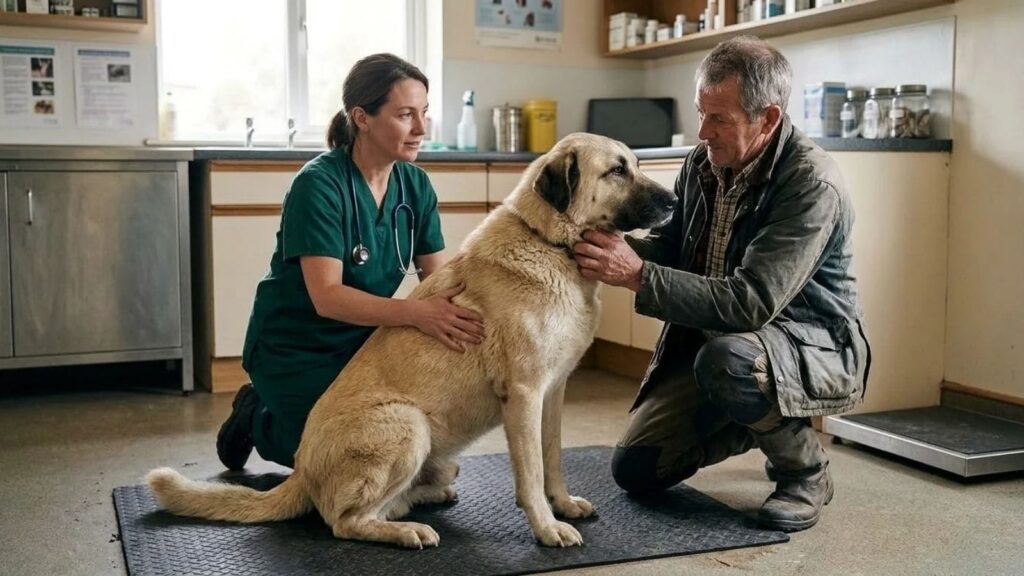
Several breed profiles in this guide mention joint conditions, including hip or elbow dysplasia. Eye conditions also appear across multiple breeds. Ask breeders which health tests are appropriate for the breed and request the results for the puppy’s parents where available.
Some profiles also mention MDR1 drug sensitivity. This genetic variation can affect how certain dogs respond to particular medications. If your dog belongs to a breed or family in which the mutation may occur, ask your veterinarian whether testing is appropriate before medication decisions are made.
Bloat, also known as gastric dilatation-volvulus (GDV), is another concern listed in some of the large-breed profiles, including the Great Pyrenees and Kuvasz. A swollen abdomen, repeated unproductive retching, excessive drooling or sudden distress can indicate an emergency. Do not wait for symptoms to pass. Contact an emergency veterinarian immediately if you suspect bloat.
Coat care varies considerably. A Border Collie generally needs routine brushing, while an Old English Sheepdog requires much more frequent attention. The Komondor’s corded coat needs specialised maintenance. Before choosing a breed, be realistic about the time and cost involved.
Farm dogs also need reliable access to clean water, suitable food, shade, shelter and routine veterinary care. Working outdoors does not make a dog immune to heat, injury, parasites or disease. Plan for preventive care and emergency transport, especially if your farm is far from a veterinary clinic.
Raising a Livestock Guardian Puppy
Raising a livestock guardian puppy requires planning. The aim is to help the young dog develop an appropriate relationship with the animals it will protect while remaining manageable and safe around people.
The SDSU Extension livestock guardian guidance explains that puppies need to bond with their flock and learn that staying with the animals is part of their role. It also warns that a dog with little or negative human contact may become aggressive, creating safety and liability concerns.
A guardian dog should not be isolated from all human interaction. It needs routine care, observation and appropriate handling. Owners must also watch how the puppy behaves around livestock. Chasing, biting or repeatedly harassing animals should not be dismissed as harmless play.
Feeding and management need attention too. Feeding arrangements should minimise waste and reduce the risk of conflict between dogs. The right approach depends on the number of dogs, the livestock setup and the farm’s daily routine.
A newer SDSU Extension article on practical livestock guardian dog management discusses safe introductions, consistent caregiver interaction, the value of suitable working conditions and the importance of considering more than one guardian dog where appropriate. These decisions should be adapted to the size and needs of the operation rather than treated as a universal rule.
FAQs
What is the best farm dog breed?
There is no single best breed for every farm. Border Collies and Australian Cattle Dogs are herding breeds, while Great Pyrenees and Anatolian Shepherds are commonly used as livestock guardians. The right choice depends on your animals, property, predator pressure and ability to meet the dog’s needs.
Can a herding dog also guard livestock?
A herding dog may alert its owner to activity, but that does not make it equivalent to a livestock guardian. Herding dogs are selected to move animals, while guardian dogs are expected to remain with and protect the flock. Choose according to the job required.
Are farm dogs good with children?
It depends on the breed and the individual dog. Some herding breeds may try to control movement by chasing or nipping at heels. Large guardian breeds may be independent or protective around unfamiliar people. Supervise interactions and teach children how to behave safely around dogs.
Do farm dogs need training?
Yes. Herding dogs need direction and suitable working skills. Guardian dogs need careful livestock introductions, supervision and appropriate socialisation. Specialist working breeds such as the Belgian Malinois require structured activity and experienced handling.
Can farm dog breeds live as pets?
Some can, but a farm background does not automatically make a dog easy to keep as a household pet. Many working breeds need substantial exercise, training or grooming. Guardian breeds may also need secure boundaries and careful management around visitors and other animals.
Conclusion
The best farm dog is not necessarily the biggest, strongest or most popular breed. It is the dog whose working instincts, temperament and care needs match the job and the environment.
Herding breeds such as the Border Collie and Australian Cattle Dog help move livestock. Guardian breeds such as the Great Pyrenees and Anatolian Shepherd are developed to stay with and protect animals. The Belgian Malinois has a specialist working profile, while the Bernese Mountain Dog is better considered a farm companion.
Before choosing among farm dog breeds, assess the work required, fencing, livestock, daily care and long-term costs. Speak with responsible breeders, meet adult dogs where possible and discuss health screening with a veterinarian. A careful match is better for the dog, the livestock and the people who depend on the farm.